
Cold Email for Staffing Agencies: Four Emails and the Name to Put on Them

Contactwho Research · How we write
Guides from the team that builds Contactwho, grounded in thousands of real buyer searches. Drafted with AI assistance, edited and fact-checked by people.
A cold email for staffing agencies that works is under 100 words, opens with a hiring signal at the reader's company, gives one like-for-like proof point, and asks a yes/no question. It goes to a named HR manager, head of talent acquisition or hiring leader, never a generic inbox, and it is followed by three more touches over two weeks.
Most staffing templates online fail before the first sentence. "Dear Hiring Manager." "Hi there." "To whom it may concern." The email is addressed to a department, so it reads like it was written to a department, and departments do not reply. The rest of the template usually confirms the impression: a paragraph about top talent, a paragraph about a trusted partnership, a calendar link.
This post does it the other way round. First the name that goes on top, from the data. Then the shape. Then four complete emails and the follow-up schedule that carries them.
The name on top: who receives a staffing email
We label a primary buying center for every search run through Contactwho. Across 371 staffing-service searches with a resolved buying center, HR leadership was the primary buying center in 50% of searches and talent acquisition or recruiting in 31%. Operations or plant leadership took 6%, the owner or executive team 5%.
That settles the department. For the title, we looked at the people who landed in a top five: 183 of them across 40 searches with title data.
| Title in the top five | Count |
|---|---|
| HR manager | 13 |
| Head of talent acquisition | 11 |
| Talent acquisition manager | 9 |
| Area sales manager | 8 |
| National account manager | 8 |
| Store manager | 6 |
| Talent acquisition specialist | 5 |
| Operations manager | 4 |
By level: manager 32%, specialist 17%, head 9%, director 7%, C-level 1%, owner 1%, with 32% unclassified.
So the email goes to a manager or a head. The CEO takes about 1 in 100 top-five slots. The sales and store managers are worth noticing: at retail and hospitality employers, the area or store manager hires directly, and an email to HR at head office is an email to the wrong building.
One more number shapes the schedule below. Across 185 staffing searches, a top five held 4.6 people, 2.5 of them primary buyers. There are usually two or three people to write to at one company: the HR manager, the head of TA if the company is big enough to have one, and the hiring leader whose reqs are open. Reading that third title off the job posting is covered in how to find hiring managers at target companies.
Trigger, proof, ask
Every email below has the same three parts, in order.
Trigger. One sentence about something that happened at their company: a role reposted for six weeks, four reqs in one job family, a new site, a new shift. Not "I came across your company". The trigger is the reason the email exists today rather than last month.
Proof. One sentence, like-for-like. A role you filled that looks like theirs: same job family, similar size, similar geography. "We place great people" is not proof. "We filled three second-shift maintenance techs for a plant your size in the same metro" is.
Ask. One yes/no question that costs the reader nothing. "Worth a 15-minute call?" is fine. "Can I send two profiles?" is often better, because it asks for permission to be useful rather than for time.
Under 100 words, because the reader is on a phone between meetings. No links in the first email. No attachments. No "I hope this finds you well".
The curly-bracket parts in the examples are yours to fill with real specifics. Do not send an invented number. Buyers in this market check.
Four cold emails for staffing agencies, each written to a named title
1. To an HR manager at a 120-person manufacturer, reposted role
Subject: the maintenance tech role
Hi {first name},
Your maintenance technician posting in {city} has been up since {month}, and it looks like it was relisted last week.
We filled {number} of the same role for a {size}-person plant nearby in the last {period}, all second shift, all still in seat.
Would it help if I sent two profiles this week, no commitment on your side?
{Your name} {Agency}, industrial maintenance and skilled trades
2. To a head of talent acquisition at a 3,000-person healthcare system, a cluster of reqs
Subject: {number} RN openings across {site}
Hi {first name},
Your team has {number} registered nurse openings live across {site} and {site}, most posted in the last three weeks. That is usually more than a team your size can screen while keeping time-to-fill where it was.
We supply {specialty} RNs to {number} systems in {state}, on contract and contract-to-hire, with credentialing done before the first interview.
Open to a 15-minute call to see whether we fit as overflow on the {specialty} reqs?
{Your name} {Agency}, clinical staffing
3. To an operations manager at a distributor, new site or shift
Subject: staffing the {city} night shift
Hi {first name},
Saw the announcement about the new {city} facility and the second shift starting in {month}. Filling 20 to 40 warehouse roles for a shift most locals have not worked before is usually the part that slips.
We staffed the opening of a {size}-person site for a distributor in {region} last {season}: {number} associates in seat by day one, {number} still there at 90 days.
Worth a call on how you plan to ramp the shift?
{Your name} {Agency}, light industrial
4. To an area manager at a retail chain, seasonal ramp
Subject: {region} holiday hiring
Hi {first name},
Your {number} stores in {region} are each listing seasonal associate roles, and the stores nearest {city} have had theirs open the longest.
We ran seasonal hiring for {number} locations of a {category} retailer in the same region last year, with a bench that let store managers backfill no-shows in under 48 hours.
Can I send you the one-page plan we used, so you can see whether it maps to your stores?
{Your name} {Agency}, retail and hospitality staffing
Notice what none of the four contains: the word "partner", a company history, a link, or a request for 30 minutes. Each one is addressed to the title our data says receives it, and each one would make no sense sent to a different company. That is the test. If your email could go to anyone, it will be read by no one.
The four-touch follow-up schedule
QuickMail's analysis of 65 million emails found 55% of replies came from a follow-up rather than the first email. A sequence with no follow-ups throws away roughly half the replies it was going to get. Four touches over two weeks is enough; twelve is a nuisance.
Touch 1, day 1. The email above.
Touch 2, day 4. Reply to your own thread. New angle, not a nudge. One sentence on what usually goes wrong with this specific hire, one on what you would do differently. For the HR manager in example 1: "One thing we see with relisted maintenance roles: the shift differential is fine but the interview loop runs two weeks, and the good techs take the other offer in week one. Happy to share how we compress that if useful."
Touch 3, day 8. Switch channel or add the second person. A LinkedIn note to the same person that references the email, or the first email to the head of TA or the hiring leader at the same company. Two or three people is normal for this purchase, and a second name in the loop often prompts the internal "are we talking to these people?" question that gets you a reply.
Touch 4, day 14. Close the loop without sounding wounded. "Guessing the timing is off. If the {role} reqs are still open next month I will check in once more; otherwise I will leave you alone." Then do exactly that.
Each touch adds something. If the second and third emails contain no new thought, they read as reminders from software, and they get treated the way software gets treated.
Before you send: the address has to be real
The best email in this post bounces if the address is guessed. Across 856 contacts we have enriched, a verified work email was found for 674 (79%). Of the 733 emails graded, 72% came back grade A, verified and deliverable, 14% grade B, 9% grade C and 5% grade D. Pattern-based guesses, the first.last@company approach, were then verified: 332 confirmed and 207 failed. A guessed address is wrong 38% of the time.
Send to guessed addresses for a month and the bounces damage your sending domain, which quietly hurts every email after that. Verify first. How to verify B2B contact data covers what "verified" means and what to do with a risky result.
Mistakes that get staffing emails deleted
Addressing a department. "Dear Hiring Manager" is the tell. If you could not find a name, you were not ready to send.
Writing to the CEO. C-level and owner titles together sit in about 2% of top-five slots. The email lands in HR anyway, minus goodwill.
Leading with the agency. Years in business, industries served, candidate database. None of it is a reason to reply this week.
Asking for 30 minutes. You have not earned it. Ask to send two profiles.
Personalising the wrong thing. A prospect's college mascot is not relevance. The role that has been open since March is.
One template for every vertical. A plant manager and a head of TA at a hospital do not think about hiring the same way. Neither should your emails.
Follow-ups that only nudge. "Bumping this to the top of your inbox" is not a touch. It is an admission you had nothing to add.
Sending to a guessed address. See above. 38% wrong is not a rounding error.
The rest of the machine that these emails sit inside, the niche, the list, the weekly review, is in business development for staffing agencies.
Questions people ask
How long should a cold email to a potential client be? Under 100 words for the first touch and shorter for the follow-ups. The reader is on a phone between meetings. Three parts, trigger, proof and ask, and nothing that does not serve one of them.
How many follow-ups should recruitment agencies send? Three after the first email, over about two weeks, then stop. QuickMail's analysis of 65 million emails found 55% of replies come from follow-ups, so skipping them is expensive. Past four touches you are training the reader to ignore you.
What response rate should I expect from cold staffing emails? Nobody can promise you one, and be wary of anyone who does. For benchmarks with a source: Sopro and Instantly's 2026 data puts the average cold-email reply at 3.43%, and Autobound's 2026 data puts signal-based outreach at 18%. Your own number will depend on your list, your niche and whether the email went to the HR manager or to info@.
What is the best time to send staffing sales emails? We have no data of our own on send time, and most published claims are vendor-specific. What we can say: send when you can answer a reply within the hour, because a fast answer to "sure, send the profiles" matters more than the day of the week.
Should I use automation for staffing outreach? Use it for reminders and for keeping the follow-up schedule honest. Do not use it to write the trigger or the proof, and do not let it send to unverified addresses. A sequence tool that fires the same "checking in" email to 400 people is how agencies get their domain blocked.
The rule
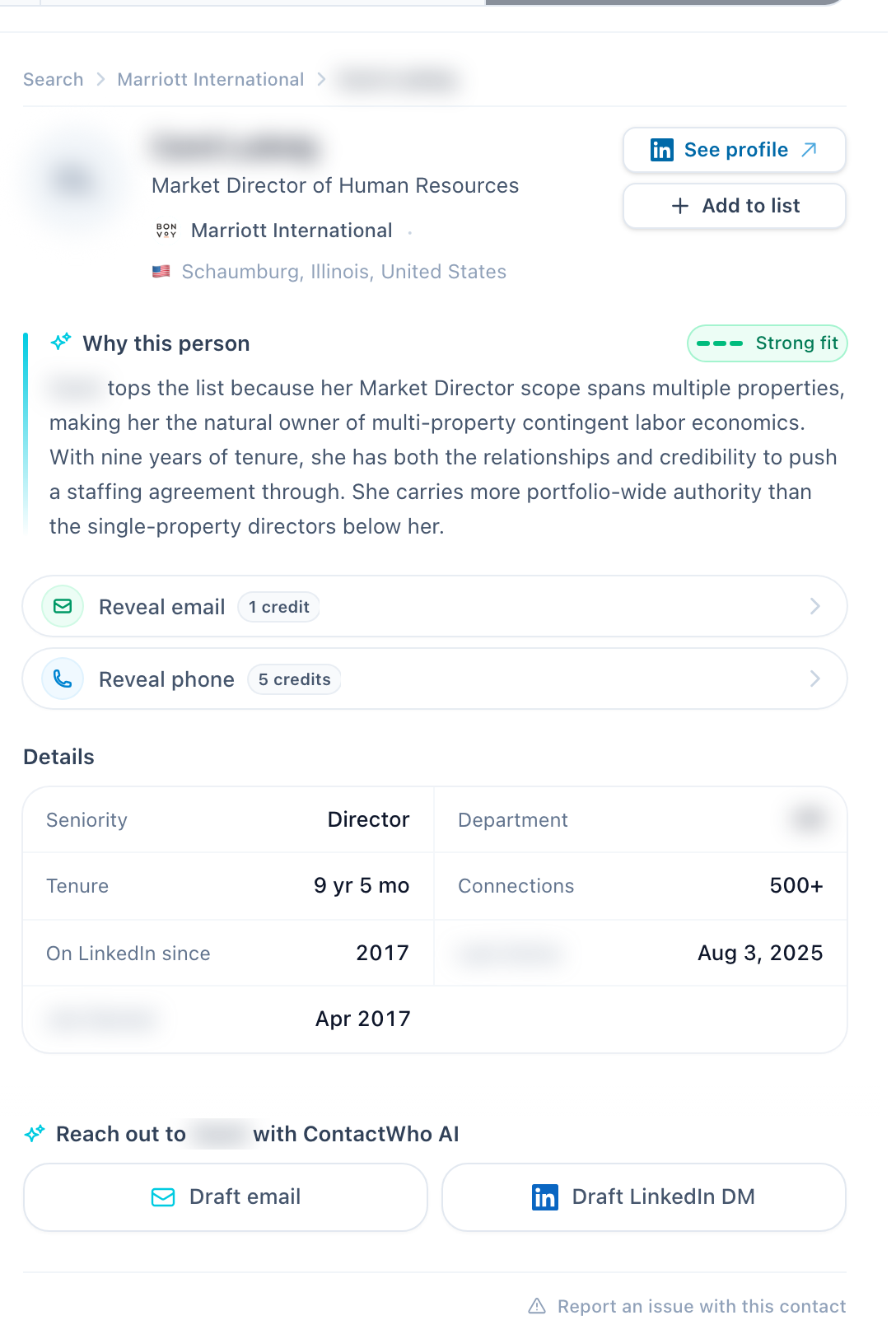
If you want the name on top and the address under it from one place, Contactwho does that step: what you place plus a company name returns the people at that company ranked by fit, with the reason each is there, and a verified email or phone when you reveal it. The trigger, the proof and the ask are still yours to write.
The rule: never send a staffing email to a department. Find the HR manager, the head of TA or the hiring leader by name, verify the address, write trigger-proof-ask in under 100 words, and follow up three times. Fewer emails to the right person beats more emails to nobody.