
How to Do Outbound Without an SDR: The Founder's Five-Hour Week

Contactwho Research · How we write
Guides from the team that builds Contactwho, grounded in thousands of real buyer searches. Drafted with AI assistance, edited and fact-checked by people.
You can do outbound without an SDR by giving it a fixed weekly hour budget, working a finite list of 20 to 50 accounts, naming the right person at each one before you write a word, and sending a three-touch sequence in your own voice. Hire an SDR only when your replies follow a pattern you can hand over.
Most founders who say outbound does not work never ran it. They bought a list, sent four hundred emails through a tool, got nothing, and concluded that outbound needs a team. It does not. It needs a calendar, a short list and the right names. The volume version fails for founders precisely because volume is the one thing a founder cannot supply.
The founder's weekly hour budget
Five hours. Blocked in the calendar, same slots every week, treated like a customer meeting.
| Day | Time | What happens |
|---|---|---|
| Monday | 60 min | Check the list for signals. Add or remove accounts. |
| Tuesday | 90 min | Name the right person at each account that moved. Write the day-1 notes. |
| Wednesday | 60 min | Send. Answer every reply the same day. |
| Thursday | 60 min | Follow-ups: day-4 and day-10 touches for earlier accounts. |
| Friday | 30 min | Review replies, wrong-person responses, objections. Tighten one thing. |
If the week gives outbound zero hours, you do not have an outbound problem. You have a calendar problem, and no SDR will fix it, because the SDR will need those same hours from you for context, coaching and reply handling.
Five hours is also the number that keeps the list honest. You cannot properly name people at 200 accounts in five hours a week. You can at 20 to 50.
How to do outbound without an SDR: the finite list
Write the ICP in three to five attributes plus one disqualifier. Something like: B2B services companies, 20 to 200 employees, one country, a sales team of two to ten, and no dedicated sales ops person. Disqualifier: anyone already running a five-tool outbound stack, because they are not your buyer yet.
Then pick 20 to 50 accounts that fit. By hand. Each one gets a line in a sheet with three columns: company, why now, and the named person. "Why now" is a signal you can point to: a job posting for a role your product helps or replaces, a new leader in the function you sell to, a product launch, a location opening. If you cannot write a why-now line, the account waits.
A finite list does two things a big list cannot. It makes each message specific, because you know why that account is on the list. And it makes the Friday review meaningful, because thirty accounts with a known why-now produce a readable pattern, and a thousand cold rows produce noise. The list is the difference between outbound and a mail merge.
For the reasoning behind keeping this in the founder's hands rather than delegating on day one, founder-led outbound prospecting covers it.
Name the right person at each account before you write anything
This is the step founders skip, and it is the reason most founder outbound goes to the CEO.
The CEO is easy to find and almost never the right person for an operational purchase. The right person is the one whose team has the problem and who can either buy or start the buying. That is a different title at every account, which is exactly why it takes ninety minutes on a Tuesday.
Our own search data makes the case for depth over breadth. Across 3,166 completed searches run through Contactwho (1,134 companies, 63 countries), the model assigned a buying mode to each search:
| Buying mode assigned | Share of searches (3,166) |
|---|---|
| Mixed committee | 36% |
| Single decision-maker | 24% |
| Owner plus evaluator | 14% |
| Procurement-led | 3% |
| Vendor-selection | 1% |
The rest were unlabeled. Across all themes, the top five people at a company held about 4.5 names per search, of which 2 to 2.6 were primary buyers.
Read that against a list. At 30 accounts, naming the two or three people who matter at each gives you 60 to 90 named people. That is a full month of outbound for one founder at five hours a week, and every message goes to someone with a reason to care. At 300 accounts with one guessed contact each, you have 300 messages to the wrong person and no idea why nothing came back. The single-decision-maker case is a quarter of searches. The rest of the time there is more than one person you need, and sending to one of them is a coin flip at best.
Practically: for each account, name the primary (the person whose team has the problem and who owns budget for it) and one secondary (the person who evaluates or has to live with the tool). Write both down before you write a word to either. If you are unsure how to tell the two apart, how to find the right decision-maker walks through it title by title.
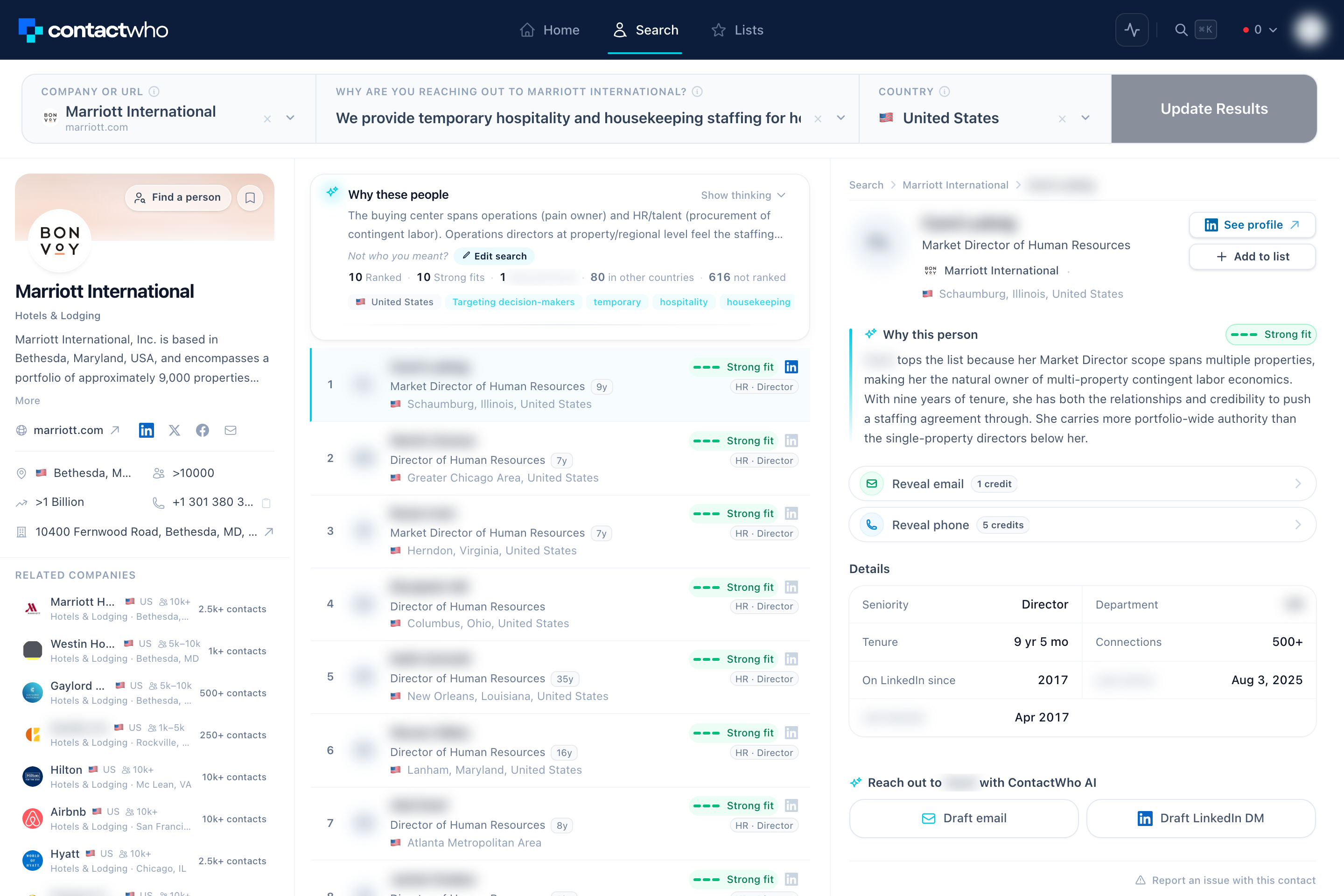
Verify the email before it goes out. In the Contactwho reveal pipeline, 856 contacts have been enriched and a verified work email was found for 674 (79%). Pattern-based guesses that were then checked failed 38% of the time. A founder with 60 named people cannot afford to lose a third of them to bounces. The mechanics are in how to find verified work emails.
A three-touch sequence a human would actually send
Three touches over ten days. Each under 80 words. Each from your real address, signed with your name and what you do. No tracking pixels, no "just circling back."
Day 1, the observation. One thing you noticed about them, one sentence on what you do, one question.
Hi [first name], saw you are hiring a second account manager for the [region] team. When teams get to that size, the account research usually ends up on the founder's plate or on nobody's. We build [one-line description]. Is that a problem for you yet, or not really?
Day 4, the proof. One concrete thing, no adjectives. A number you can stand behind, a short description of how a similar company uses it, or a screenshot.
Following on from Monday. One thing that might be useful: [specific, verifiable detail about how the product works or what it produces]. If it is relevant to the [region] hire, happy to show you in 15 minutes. If not, say so and I will stop.
Day 10, the honest close. Ask directly and let them off the hook.
Last note from me. If this is not a priority this quarter, that is a perfectly good answer and I will check back in [month]. If it is, what is the best way to have a short look?
Then stop. A fourth touch to someone who has ignored three is not persistence. It is noise, and it teaches the account to ignore your domain. Put them back in the list with a check-back date.
Every reply gets answered the same day by you, in your own words. This is the part an SDR cannot do yet, because the SDR does not know what you know about the product, and the replies are where you learn what the market actually hears when you describe it.
Stop rules: when to hire the first SDR
Hire the first SDR when all five are true, not when you are tired.
- You have hit the five-hour budget for eight consecutive weeks. If you cannot run it for two months, you cannot manage someone running it.
- The same two or three objections keep coming back, and you have written answers to them. Repeatable objections are the sign of a repeatable segment.
- At least one customer came from the sequence sent as written. Not a referral, not an inbound. The sequence, to a named person, unchanged.
- The ICP, the disqualifier and the person-naming rule fit on one page, and someone who has never met you could apply them to a new account.
- The bottleneck is your hours, not your replies. More named people are waiting than you can send to, and the reply pattern is stable.
Do not hire because nothing is replying. Silence is a targeting or naming problem, and an SDR will scale it. Do not hire because you want to stop doing outbound. The first SDR needs you more than the sequence does. When you do hire, hand over the list, the person-naming rule and the sequence, and keep answering the replies yourself for the first month.
Mistakes founders make in the first month
Buying a list and calling it research. A list gives you companies. It does not give you the why-now or the right person, and those are the whole job.
Treating the CEO as the default recipient. Right person at every account, chosen for that account, or the message does not go.
Writing in vendor voice. "We help forward-thinking companies transform their..." No. Write the way you would write to a former colleague. Short, specific, a bit blunt.
Adding a fourth, fifth and sixth touch. Three touches, then a check-back date. The list is finite so you can come back to it.
Automating before the pattern exists. Sequencing tools are fine once you know what to sequence. Before that, they turn a bad message into a bad message at scale. The right automation on day one is a verified email, not a drip.
Skipping the Friday review. Thirty minutes. Which accounts replied, who bounced, who forwarded it, what the objection was. Change one thing next week, not four.
Questions people ask
How many accounts should a founder target? Twenty to fifty at a time, each with a written why-now and a named person. In our search data the top five people at a company average about 4.5 names, of which 2 to 2.6 are primary buyers, so 30 accounts is already 60 to 90 real people. That fills five hours a week. Bigger lists mean shallower naming and messages that are not about the account.
When should a startup hire its first SDR? When the founder has run the five-hour budget for eight straight weeks, at least one customer came from the sequence unchanged, the recurring objections have written answers, the targeting rules fit on one page, and the constraint is founder hours rather than replies. Hiring before that hands someone a guess and asks them to scale it.
What should a founder automate first? Email verification and the reminders for day-4 and day-10 follow-ups. Not the writing, not the sending, not the replies. Verification is worth it immediately: pattern-guessed addresses failed verification 38% of the time in our reveal pipeline, and a bounce at a named account is a wasted signal.
How do I measure whether outbound is ready to scale past the founder? Look for a stable pattern, not a big number. The same segment replies for the same reason, the same objections show up, and you can predict who at a new account will answer. When your Friday review has read the same way for a month, the motion is describable, and only describable motions survive a handoff.
The next 30 days
One tool note, since naming the person is the slow part. Contactwho takes what you sell plus a company name and returns the people there ranked by fit, with the reason for each, and reveals a verified email or phone when you ask for one. It is built for this step at 20 to 50 accounts, not for exporting ten thousand rows. The list, the why-now and the writing stay with you.
The plan:
- Week 1. Block the five hours. Write the ICP, the disqualifier and the person-naming rule on one page. Build 20 to 30 accounts, each with a why-now line.
- Week 2. Name the primary and secondary person at each. Verify the emails. Send day-1 to the first 15 accounts on Wednesday.
- Week 3. Day-4 and day-10 follow-ups. Day-1 to the next 15. Answer every reply the same day. First Friday review that changes one thing.
- Week 4. Finish the sequence for all 30. Write down the objections you have heard and your answers. Score the five stop rules honestly.
Most founders will have none of the five met at day 30. That is fine. The point of month one is a list that is real, a pattern that is starting, and five hours that held.