
Business Development for Recruitment Agencies: Work 50 Named Companies, Not 5,000 Cold Emails

Contactwho Research · How we write
Guides from the team that builds Contactwho, grounded in thousands of real buyer searches. Drafted with AI assistance, edited and fact-checked by people.
Business development for recruitment agencies works when it runs as a weekly system, not a mood. Each consultant works a named list of 50 to 100 companies, watches for live vacancies, contacts the hiring manager and the HR or talent lead who manage agencies, runs a BD call, and sends a spec CV only when it is a real match.
Most agencies do not have a lead problem. They have a consistency problem. A consultant with a quiet morning fires off twenty LinkedIn messages, gets two polite refusals, then a placement lands and BD stops until the next quiet morning. That is not business development. That is intermittent effort with a CRM attached.
It stops because it has no list and no trigger. Without a named list, every BD session starts with "who should I contact?" and that question alone eats the hour. Without a trigger, every message is a generic "we place great people" pitch the hiring manager has received nine times this month. Fix the list and the trigger and the rest gets simpler.
Business development for recruitment agencies starts with 50 to 100 named companies
Pick the companies before you pick the message.
An ICP for a recruitment desk is not "SMEs in the Midlands." It is a short set of filters a consultant can apply to any company in ten seconds:
- Sector you have actually filled roles in, not sectors you would like to.
- Size band. Under 50 employees, 50 to 249, 250 to 999, 1,000 plus. Pick two adjacent bands at most.
- Geography where your candidates are.
- Roles. The three or four job families your last twenty placements fell into.
- One disqualifier. Companies with an in-house recruitment team of five or more, or those that run everything through an MSP, or whatever has wasted your time before.
Apply that and write down 50 to 100 company names per consultant. Named. In a sheet or the CRM, with a column for "last vacancy seen" and one for "who we know there." That list is the desk's territory for the quarter. Nothing off the list gets cold outreach unless it is a referral.
Fifty is enough that a few will have a live vacancy in any given week. A hundred is the most one consultant can watch while running a desk. Five hundred is a list nobody watches.
Vacancy-triggered outreach to the hiring manager
The trigger is a live vacancy at a company on your list. Not a funding announcement, not a LinkedIn post about culture. A vacancy, ideally one of these:
- a role re-advertised after four to six weeks
- two or more vacancies on the same team
- a vacancy in a job family you have filled in the last twelve months
- a new head of department who has just started and is now hiring beneath them
When it fires, contact two people: the hiring manager whose team has the vacancy, and the HR or talent lead who manages agency relationships. The posting tells you the first one. Its department, level and location point to the person one level above the role, and we laid out the method in how to find hiring managers at target companies.
The message is short. Under a hundred words. Something like:
Subject: your [role title] vacancy
Saw the [role] you have open in [location]. We filled the same role for a [sector] business of about your size in [month], from brief to start date in [n] weeks. Not asking for a PSL slot. Would it be useful if I sent one profile across for that vacancy, yes or no?
One vacancy, one like-for-like fill, one yes-or-no ask. Every claim in it true. No deck, no "who is the best person to speak to," no list of services. Then two follow-ups a few days apart, and if nothing comes back, the company stays on the list and you wait for the next vacancy. More wording along these lines is in cold email for staffing agencies.
Who holds the agency relationship: HR at 50%, talent at 31%
Consultants argue about whether to go to HR or the line manager. The data says both, with HR ahead.
In 574 staffing and recruiting searches run through Contactwho (371 with a resolved buying center), HR leadership was labeled the primary buying center 50% of the time and talent acquisition or recruiting 31%. Operations or plant leadership owned it 6% of the time and the owner or an executive 5%. Grouped by employer size (n = searches with a matched company size):
| Employer size | HR leadership | Talent acquisition | Operations | Owner / exec | n |
|---|---|---|---|---|---|
| Under 50 | 53% | 22% | 2% | 6% | 546 |
| 50 to 249 | 50% | 29% | 13% | 3% | 356 |
| 250 to 999 | 53% | 27% | 10% | 3% | 261 |
| 1,000 to 4,999 | 57% | 36% | n/a | 2% | 175 |
| 5,000 plus | 50% | 33% | 3% | 3% | 572 |
Two readings. First, the owner or MD is the buyer only in a small minority even at companies under 50 people. Second, talent acquisition's share grows with size, from 22% under 50 employees to 36% at 1,000 to 4,999. Above a thousand people, expect a TA team with its own opinion about agencies, and expect the PSL to sit with them.
The line manager is still where the vacancy lives, and the top five per search reflects that pairing: across 185 staffing searches with a top five, the ranked list held 4.6 people on average, 2.5 of them primary buyers and 1.3 secondary. Two or three people per company, not one.
The BD call: what to cover, in order
When someone says yes to the yes-or-no question, you get a call. Most consultants pitch on it. Do not. Listen for most of it and ask, in this order:
- What is live. The vacancy that triggered you, plus anything else open on the team. Start date, salary band, must-haves versus nice-to-haves.
- What has been tried. Direct advertising, referrals, another agency, how long it has been open, and what the shortlist looked like.
- How they use agencies today. Is there a PSL, who owns it, when is it reviewed, and what do the current agencies do well or badly?
- How they judge an agency. Time to shortlist, quality of the first three CVs, how much hand-holding on interview logistics.
- Terms. Fee, rebate, exclusivity on this one role. Say your number plainly and stop talking.
- The next step. One profile by Thursday, or a briefing call with the hiring manager if you have been speaking to HR. Get a date.
Write the answers into the account record. Even if this vacancy goes nowhere, questions three and four tell you exactly how to approach the account next time.
PSL dynamics: getting on one, and working around one
The preferred supplier list is owned by the client, usually HR or TA, sometimes procurement above 1,000 employees. Agencies get added in one of two ways: at a periodic review, or because someone inside asked for you. The second is far more common for a small agency.
That someone is a hiring manager with a vacancy the PSL agencies have not filled. Your job is to be the agency they ask for. Which means the vacancy-triggered motion above is also your PSL strategy: fill the hard role off-list once, on an exception, and let the hiring manager make the case to HR. We covered the approval chain in who approves staffing vendors.
When you are not on the list:
- Ask HR when the PSL is next reviewed and what the criteria are. Put the date in the CRM.
- Ask the hiring manager whether they can request an exception for this role. Many can, for roles open past a certain number of weeks.
- Target the roles the PSL is failing on. Re-advertised vacancies are the tell.
- Do not apply through a supplier portal and wait. Nobody reads it.
The spec CV: when it works and when it is spam
A spec CV is a candidate profile sent to a hiring manager who has not asked for it. Done well it is the single fastest way to open an account. Done badly it is the reason hiring managers block agency domains.
The rule: send a spec CV only when all three of these are true.
- There is a live or recently re-advertised vacancy at the company that matches.
- The candidate is a like-for-like match on the posting's must-haves, not "a strong profile you might like."
- The candidate has agreed to be put forward to that company by name.
If any one of the three is missing, do not send it. One profile per vacancy, per hiring manager, in the body of the email as five lines: current role, sector, two relevant achievements, location and notice period, salary expectation. Not the full CV as an attachment. Not three profiles "to give you a choice."
A spec CV that meets all three conditions is a service. One that meets two is a guess. One that meets one is spam with a candidate's career attached.
Mistakes that keep an agency stuck on referrals
Treating the network as the system. Referrals are welcome and uneven. Staffing Hub's 2025 survey found 86% of fast-growth agencies run a formal referral program against 60% of no-growth agencies. Even formalized, referrals will not give you 50 named companies to watch.
Pitching capabilities. "We are a specialist agency with a strong network" is what every agency says. The vacancy in the subject line is what distinguishes you.
Going to the MD at a 40-person company. The owner or executive is the labeled buyer in 6% of our under-50 searches. HR is the buyer in 53%.
Quitting after one uninterested month. The company is still on the list. The next vacancy is the next trigger. Business development for recruitment agencies only works when it survives your busiest month and your quietest inbox.
Measuring sends. Count vacancies spotted, hiring managers named, BD calls held and briefs taken. Sends are activity. Briefs are pipeline.
Questions people ask
What is business development in recruitment? It is the client side of the desk: finding companies with vacancies you can fill, reaching the hiring manager and the HR or talent lead who manage agencies, agreeing terms, and taking a brief. Candidate work fills the vacancy. BD is how you get the vacancy in the first place.
How do recruitment agencies get their first client? Usually from a vacancy at a company where the consultant already knows the sector and has a matching candidate. Pick 50 companies in that sector, watch for vacancies, send a short vacancy-specific note to the hiring manager, and offer one profile. The first client comes from a fill, not a pitch.
What should a recruitment BD call cover? What is live, what has been tried, how they use agencies today and whether there is a PSL, how they judge an agency, terms, and one concrete next step with a date. Ask the questions in that order and let the client do most of the talking.
How do you get onto a preferred supplier list? By having a hiring manager inside the company ask for you, usually after you have filled a hard role on an exception. Find out when the PSL is reviewed and what the criteria are, and target the vacancies the current suppliers are failing on. Portal applications on their own rarely lead anywhere.
The next 30 days
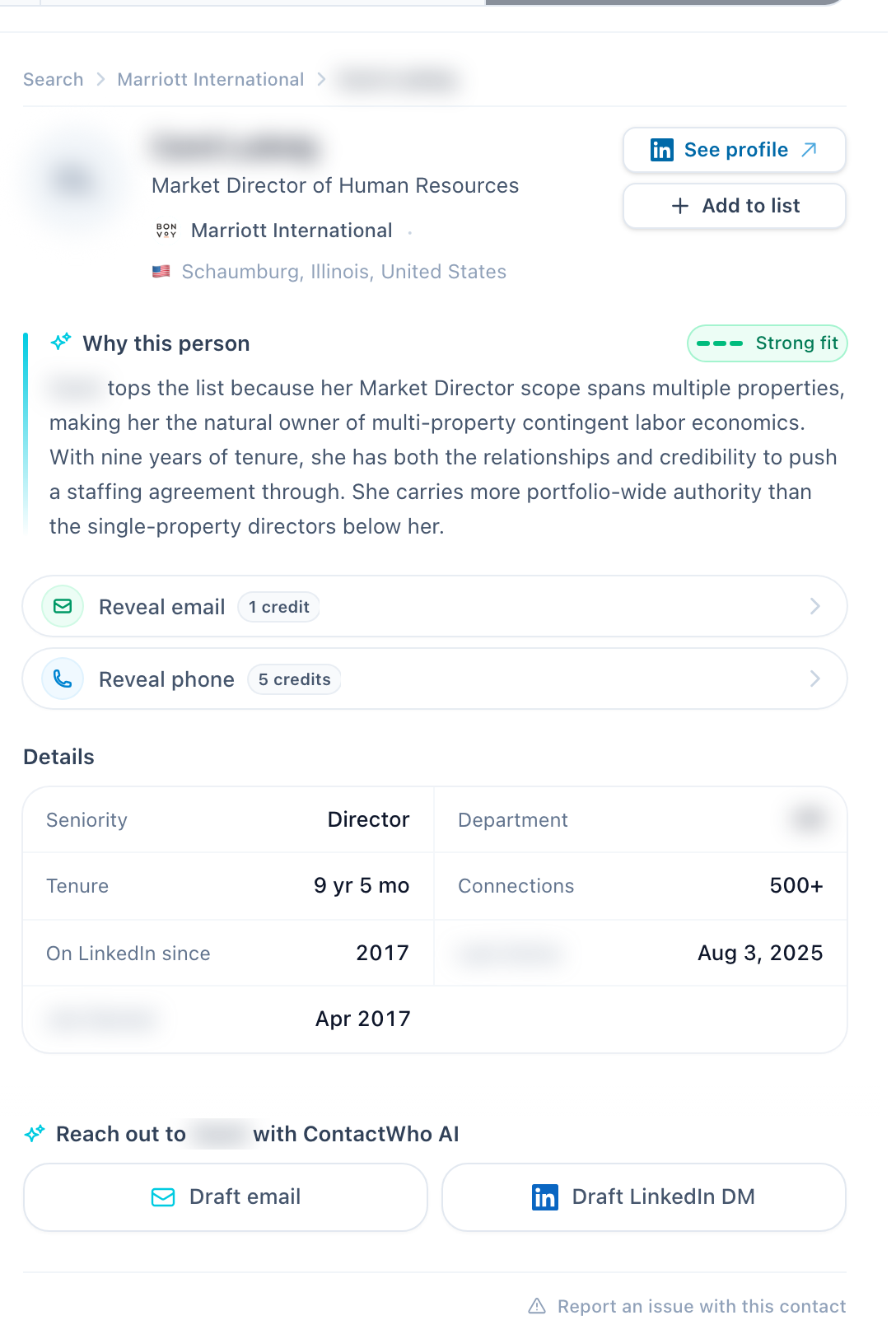
One tool note. If naming the two people at each company is the slow part, Contactwho takes what you place plus the company name and ranks the people there by fit, with a reason for each and a verified email or phone on reveal. It does not tell you when the vacancy went live. That part is still your list and your eyes.
The plan:
- Week 1. Write the ICP filters and the disqualifier. Build the named list of 50 to 100 companies per consultant. Add the "last vacancy seen" column.
- Week 2. Check every company on the list for live vacancies once. For each trigger, name the hiring manager and the HR or TA lead. Send the vacancy-specific note to both.
- Week 3. Follow up twice. Hold the BD calls that come back using the six questions. Log answers three and four for every account.
- Week 4. Send spec CVs only where all three conditions hold. Ask every HR contact when the PSL is reviewed. Count vacancies spotted, managers named, calls held, briefs taken.
Then run week two again. That is the system.