
How to Find HR Decision Makers for Staffing Services: A Title Map by Company Size

Contactwho Research · How we write
Guides from the team that builds Contactwho, grounded in thousands of real buyer searches. Drafted with AI assistance, edited and fact-checked by people.
How to find HR decision makers for staffing services: go by company size, not seniority. In 574 staffing-service searches in our corpus, HR leadership was the primary buyer in 50% and talent acquisition in 31%, and the top-five names were HR managers and heads of TA, not CHROs. Find that band, verify the email, pair it with the hiring leader.
Most "HR decision maker" lists are built the lazy way: filter a database for HR, director and above, export, send. The result is a spreadsheet of people who are senior enough to ignore you and far enough from the reqs not to care. The buyer is usually one or two levels down and one function over, and which one depends on how big the company is.
The title map by company size
Each search in our corpus is one company plus one plain-language description of what the agency places. We label the department that owns that purchase, which we call the primary buying center, and rank the company's people by fit. Here is how the staffing purchases split by employer size, with the titles we would look for first in each band. The percentages are from the data; the title column is our reading of which roles sit inside those departments at that size, informed by which titles actually landed in the top five.
| Employer size | HR leadership | TA / recruiting | Owner / exec | Look for first |
|---|---|---|---|---|
| Under 50 | 53% | 22% | 6% | HR manager or HR generalist; the owner only if there is no HR function |
| 50 to 249 | 50% | 29% | 3% | HR manager; TA specialist; operations manager for hourly roles (ops is 13% in this band) |
| 250 to 999 | 53% | 27% | 3% | HR manager for the site; TA manager; head of TA if one exists (ops is 10% here) |
| 1,000 to 4,999 | 57% | 36% | 2% | Head of talent acquisition; TA manager for the function; site HR manager |
| 5,000+ | 50% | 33% | 3% | Head of TA for the region or function; TA manager; site or division HR manager |
Sample sizes per band, top to bottom: 546, 356, 261, 175 and 572 searches with a matched company size.
Three things the map says that a purchased list does not.
First, HR is the most likely owner at every size. There is no band where "skip HR" is good advice.
Second, TA's share rises with size, from 22% under 50 employees to 36% at 1,000 to 4,999. Below a few hundred people, the HR decision maker is a generalist HR manager who also runs the agency relationships. Above a thousand, it is a dedicated head of talent acquisition or TA manager with a vendor list and a fee cap. Same purchase, different desk.
Third, on seniority: across 183 top-five people in 40 staffing searches with title data, the most common titles were HR manager (13), head of talent acquisition (11), talent acquisition manager (9) and talent acquisition specialist (5). By level, managers were 32%, specialists 17%, heads 9%, directors 7% and C-level 1%. Directors and above are a thin slice. Managers and heads are the buyers.
When HR is the buyer and when HR is the gate
Here is the distinction no title list makes, and it decides what you write.
HR or TA is the buyer when the purchase is a program rather than a role. High-volume temp, seasonal ramps, multi-site hourly hiring, RPO, a preferred-supplier list, an MSP. In those cases the agency spend sits in HR or TA's budget, they own the vendor list, and they decide whether you get a trial. By count this is most of the market: 81% of our staffing searches resolved to HR or TA as the primary buying center.
HR or TA is the gate when the purchase is one hard-to-fill role with a budget that belongs to the hiring leader. The leader has the pain and the money; HR or TA runs the process and can still block you with "we don't use agencies", a fee cap, or an existing preferred list. You still need them. You just need them to say yes to a decision someone else is making.
The test question, once you have someone on the phone: does agency spend sit in your budget, or does it get charged back to the department doing the hiring? The answer tells you which mode you are in. It also tells you who else to write to.
Pair every HR contact with the hiring leader
Even in our data, the buyer is rarely one person. In 185 staffing searches with top-five data, we marked 4.6 people on average: 2.5 primary buyers, 1.3 secondary, and 0.7 influencers or stakeholders. Gartner's research puts B2B buying groups at 6 to 10 stakeholders; staffing is simpler than that, but it is still not one inbox.
So the working unit is a pair: the HR or TA owner, plus the hiring leader whose reqs are open. The owner is your recipient. The leader is your reason. When the hiring leader is an operations manager at a 300-person manufacturer, they may also be a co-buyer; operations was the primary buying center in 10% of searches in that band.
The leader's likely title comes from the job posting itself: department, level and location, then one level up. We have the full method in how to find hiring managers at target companies. For the wider question of why HR owns the purchase in the first place, the numbers are in who buys staffing services at a company.
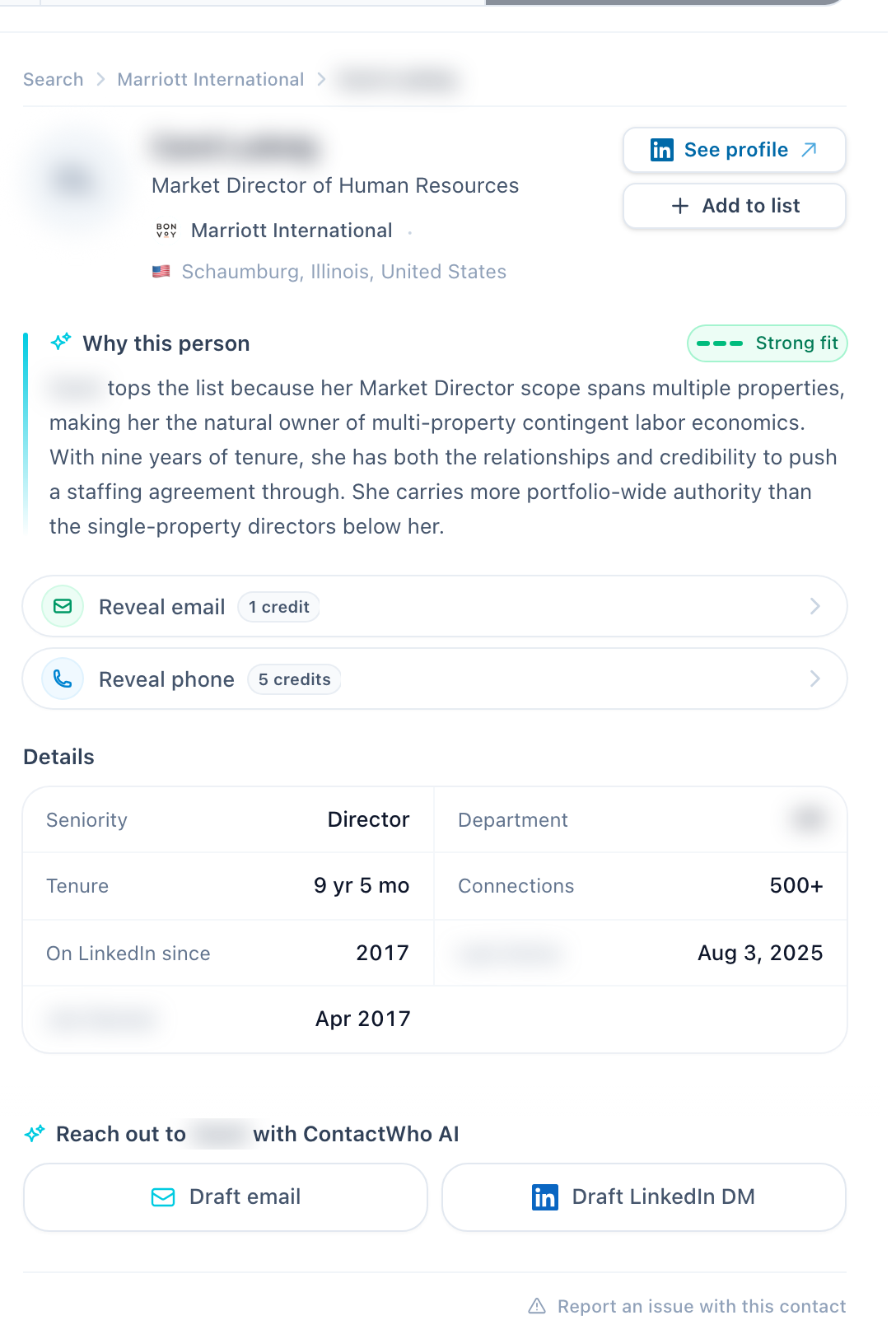
How to find HR decision makers for staffing services: the workflow
This takes about fifteen minutes per company once you have done it a few times.
- Start from a signal, not a list. Three or more open reqs in one function, a new site, a seasonal ramp, a newly hired head of TA. No signal, no company on the list this week.
- Get the headcount. It picks the row in the table above. Do not guess from the logo.
- Pick the title band. Under 250: HR manager. 250 to 4,999: TA manager or head of TA, plus the site HR manager. 5,000+: head of TA for the region or function.
- Confirm the individual by scope. A 5,000-person company has several people with the right title. Take the one whose scope covers the site, region or function where the reqs are. Their profile usually says.
- Find the hiring leader. From the posting: department, level, location, one level up. Add them to the pair.
- Verify the email before you send. In our reveal pipeline, a verified work email was found for 674 of 856 enriched contacts, or 79%. Of the 733 graded, 72% were grade A (verified, deliverable), 14% B, 9% C and 5% D. Pattern-based guesses that were then verified came back wrong 38% of the time. ZeroBounce puts annual email list decay at 23%. Send only A and B, and re-verify anything older than a quarter. More on the mechanics in how to verify B2B contact data.
- Write two messages. To the HR or TA owner: the reqs, one like-for-like proof point, a yes/no ask for a trial req. To the hiring leader: the reqs, what you can have on their desk by when, and a note that you have written to their HR or TA counterpart. Under 100 words each.
- Log the roles, not just the names. Owner, leader, gate. Next month, when the reqs change, the map still works.
Mistakes that make an HR list worthless
Buying an "HR director" list. Directors were 7% of top-five slots in our data. You have paid for the wrong level.
Treating every HR title as the same job. People operations, HR business partner, total rewards, recruiting operations, talent acquisition. Only some of these own agency relationships. At a 3,000-person company, the head of TA does; the HR business partner for finance does not.
Emailing the CHRO. C-level was 1% of top-five slots. A CHRO at a 5,000-person company is not the person who decides whether a new agency gets a trial req.
Skipping the hiring leader. The HR owner without a reason to act will file you. The reqs are the reason.
Guessing the email pattern and sending anyway. 38% of pattern guesses failed verification in our pipeline. That is not a rounding error, it is a bounce rate that gets your domain flagged.
Assuming the recruiter on the job ad is the owner. Sometimes yes: TA specialists made the top five in our data. Often they are a sourcer with no say over vendors. Check scope before you decide they are the buyer, and treat their presence as evidence that a TA function exists.
Questions people ask
What is the difference between an HR manager list and an HR directors list? Level, and therefore relevance. In our staffing data, managers were 32% of top-five slots and directors 7%. For staffing sales the HR manager list is closer to the buyer at companies under a thousand people; above that, the title you want is head of TA or TA manager, which is on neither list. Buy by function and scope, not by seniority.
Are HR email lists GDPR compliant? Not by default. Compliance depends on how the data was collected, the lawful basis you rely on (for B2B outreach, usually legitimate interest), whether the message is relevant to the person's role, and whether you offer an easy opt-out and honor it. A list vendor's claim is not your compliance. If you sell into the EU or UK, get advice on your own process rather than trusting the export.
How do I verify HR emails before sending? Run a live mailbox verification on every address, keep only results graded as deliverable, and re-check anything more than a few months old. In our pipeline, 79% of enriched contacts came back with a verified work email, and 38% of pattern guesses failed. Verification is not the last step of list-building; it is what turns a guess into a contact.
What tools help identify hiring managers? The job posting is the first tool: its department, level and location point to the leader one level above the role. After that, a contact database with title and scope filters, a people search that ranks by fit at one company, and an email verifier. What you want from any tool is the specific person whose scope covers the reqs, not more records.
The next 30 days
Contactwho does steps two through six in one pass: type what you place and a company name, and it returns that company's people ranked by fit with the reason each one is there, then reveals verified emails and direct dials for the ones you choose. Searches are unlimited on every plan, including the 14-day trial; credits are spent on reveals only.
Tool or no tool, here is the plan. Week one: pick 25 companies with live hiring signals in your niche and get their headcount. Week two: for each, name the HR or TA owner by band and the hiring leader from the posting, and verify both emails. Week three: send the two-message pair to every company, then three follow-ups over ten days. Week four: sort the 25 by what happened, keep the pattern that got replies, and add the next 25. Fifty mapped companies beats five thousand filtered rows. Smaller list, sharper aim.