
Business Development for Staffing Agencies Without the Spray-and-Pray

Contactwho Research · How we write
Guides from the team that builds Contactwho, grounded in thousands of real buyer searches. Drafted with AI assistance, edited and fact-checked by people.
Most small agencies don't have a lead problem. They have a consistency problem. Business development for staffing agencies works when it runs as a weekly system: one niche, a finite list of companies with live hiring signals, the named HR or talent acquisition manager who manages agencies there, a message tied to that signal, and follow-up that outlasts the inbox.
If that sounds almost too basic, good. Basic is usually what works. The complicated stuff is often just avoidance wearing a nicer outfit.
But there is one part of that sentence every guide on this topic waves past: the person. "Reach decision-makers" is the standard advice. Nobody says which ones. So this post spends most of its time there, using what we see across 574 staffing-service searches run through Contactwho, and then folds the answer back into a system you can run on a Friday afternoon.
Why outbound breaks down for good agencies
A lot of boutique firms are better at delivery than at creating demand. That makes sense. Delivery gets rewarded this week. Business development gets rewarded in a quarter, if at all.
So the pattern looks like this. You get busy filling roles. Outreach slows down. The client pipeline dries up 60 to 90 days later. Panic kicks in. You blast a bigger list with weaker messaging. Results stay mediocre, and now you are convinced outbound doesn't work in your market.
The effort was never the issue. It was badly timed, aimed at the wrong desk, and too easy to stop.
If your pipeline depends on mood, spare time, or desperation, it isn't a pipeline. It's just intermittent effort.
Who actually buys staffing services at a company
Here is the part the top-ranking pages on business development for staffing agencies leave out.
We label a primary buying center for every search that comes through: the department that owns the purchase for that company and that intent. Across the 371 staffing-service searches with a resolved buying center, HR leadership was the primary buying center 50% of the time and talent acquisition or recruiting 31%. Operations or plant leadership took 6%. The owner or executive team took 5%. Everything else split the remaining 8%.
Read that again if you have been opening with the CEO. The owner is the buyer in one search out of twenty.
The more useful cut is by employer size, because it shows how little the answer moves.
| Employer size | HR leadership | TA / recruiting | Operations / plant | Owner / exec |
|---|---|---|---|---|
| Under 50 (n=546) | 53% | 22% | 2% | 6% |
| 50-249 (n=356) | 50% | 29% | 13% | 3% |
| 250-999 (n=261) | 53% | 27% | 10% | 3% |
| 1,000-4,999 (n=175) | 57% | 36% | not labelled | 2% |
| 5,000+ (n=572) | 50% | 33% | 3% | 3% |
Share of searches by primary buying center, where n is the number of searches with a matched company size. Rows do not sum to 100; the remainder is "other".
Three things to take from that table.
HR owns it at every size. Not once does HR leadership drop below half. The instinct that "at a 40-person company you sell to the owner" is mostly wrong: even under 50 employees, the owner or executive is the labelled buyer only 6% of the time.
Talent acquisition grows with size. TA's share climbs from 22% under 50 employees to 36% at 1,000 to 4,999. Once a company is big enough to have a recruiting function, that function manages the agencies.
Operations matters in the middle. At 50 to 999 employees, operations or plant leadership is the primary buyer in 10% to 13% of searches. That is the light-industrial and multi-site world where a plant manager hires directly and HR catches up later.
For the longer version of this, including how the hiring leader fits alongside HR and TA, see who buys recruiting services at a company.
The titles that end up in the top five
Department tells you where to look. Title tells you who to write to.
Across 185 staffing searches where we marked a top five, the list held 4.6 people on average: 2.5 primary buyers, 1.3 secondary buyers, and 0.7 influencers or stakeholders. That is the shape of a staffing purchase. Not one person. Not a committee of ten. Two or three people who can say yes, plus one or two who will be asked.
Among 183 top-five people across 40 searches with title data, the titles that showed up most were:
- HR manager (13)
- Head of talent acquisition (11)
- Talent acquisition manager (9)
- Area sales manager (8)
- National account manager (8)
- Store manager (6)
- Talent acquisition specialist (5)
- Operations manager (4)
By management level: manager 32%, specialist 17%, head 9%, director 7%, C-level 1%, owner 1%, with 32% unclassified.
So the person you should email is usually a manager or a head, not a VP and not the CEO. C-level titles filled about 1 in 100 top-five slots. The sales-manager titles are not noise either; they show up at retail and hospitality employers where store and area managers hire their own people, and an agency that understands that wins the account from the floor up.
Business development for staffing agencies as a weekly system
With the buyer named, the rest of the machine is simple. Simple, not easy.
1. Start narrower than feels comfortable. "Any company that hires" is not a niche. Manufacturers hiring skilled trades in two states is. PE-backed healthcare services groups scaling leadership teams is. Pick the lane where you already have placements, candidates or proof, because that is where your outreach can sound like judgment instead of a brochure.
2. Build a list of 100 to 300 companies, not 10,000. Each row needs the company, its hiring footprint, the trigger you noticed, and the two or three people you intend to contact. Names without context produce generic emails. Context without names produces nothing.
3. Work from triggers, not hope. Job-posting clusters, a new location, a funding event, a leadership change, the same maintenance-tech role reposted for six weeks. Timing beats copy. Average messaging with a live trigger books more meetings than polished messaging into a company that has no reason to care today. How staffing agencies find clients walks through the signal-to-person-to-message chain in more detail.
4. Name two or three people per account, using the data above. The default set is the HR manager or HR director, the head of TA or TA manager where the company is big enough to have one, and the hiring leader whose team owns the open reqs. At a 30-person company that third seat is often the owner. At a 3,000-person company it is a department head. Writing to all three in the same week, with slightly different angles, is not spam. It is how a purchase that involves 2.5 primary buyers gets made.
5. Run a short, believable sequence. Day 1: email with one specific observation and a yes/no ask. Day 3: LinkedIn note or second email with a different angle. Day 7: a call that references the hiring context. Day 10: one useful idea or a like-for-like example. Day 14: a final note that closes the loop without sounding wounded. The emails themselves are covered in cold email for staffing agencies.
6. Track leading indicators every Friday. New accounts added. Contacts named per account. First touches sent. Follow-ups completed. Conversations started. Meetings booked. Reactivation touches to old clients. When pipeline goes soft you stop asking "why is it weak" and start asking "which part of the machine did we stop running".
Mistakes that quietly kill momentum
Emailing the CEO because it feels senior. Owners and C-level titles together sit in about 2% of top-five slots in our data. The message gets forwarded to HR at best, and at worst it arrives with a note that reads "handle this".
Quitting after two touches. People are busy. Silence is not always rejection. If the targeting is decent, no response usually means "not seen" or "not now", not "never".
Treating referrals as a strategy. Referrals are wonderful. They are also not a system. If they carry the business, you are more exposed than you think.
Sending capability emails. Nobody needs another paragraph about top talent, speed, quality and partnership. Those words have been stripped of meaning through overuse.
Using one message for every size of company. A 40-person employer where the HR manager also runs payroll and a 5,000-person employer with a TA team of twelve do not read the same email the same way. Same buyer department, different day job.
Treating old relationships like dead leads. Former clients, almost-clients, hiring managers you placed years ago who now run their own teams. These are the easiest pipeline you have, and most firms ignore them because chasing new logos feels more legitimate. It usually isn't.
The part owners resist: making it boring on purpose
Most agency owners quietly want business development to be exciting. One great email, one big campaign, one lucky introduction. Reliable business development for staffing agencies is repetitive by design. A defined niche. A living list. The right two or three names at each account. Useful messages. Follow-up discipline. A Friday review.
Once that runs, the network gets more valuable, not less. Warm introductions land better on top of a real process. Founder visibility converts when someone is turning attention into meetings. Outbound should support your reputation, not replace it.
Questions people ask
How does a new staffing company find clients? Start with the market you already know from your placements, build a list of 100 companies in it with visible hiring activity, and write to the HR manager or head of talent acquisition at each with a message tied to that activity. Most new agencies over-invest in a website and under-invest in a named list. The list is the business.
What are the key steps in business development for a staffing firm? Pick one niche, build a finite target list, attach a trigger and two or three named contacts to each account, run a five-touch sequence over two weeks, and review the leading indicators weekly. Then expand won accounts before hunting new ones. Nothing in that list is clever. All of it is skippable, which is why most firms skip it.
What is business development in recruitment? It is the work of turning a company that could use your service into one that does: finding it, reaching the right person, earning a conversation and converting it into signed terms or a first req. Marketing creates awareness and lead generation creates opportunities. Business development is the part that closes the distance.
How can small staffing agencies compete with enterprise firms? Big firms default to broad targeting and generic copy because their volume demands it. A boutique that knows one niche can write to an HR manager about the exact role that has been open for six weeks. Focus reads as credibility. Vagueness is the handicap, not size.
The next 30 days
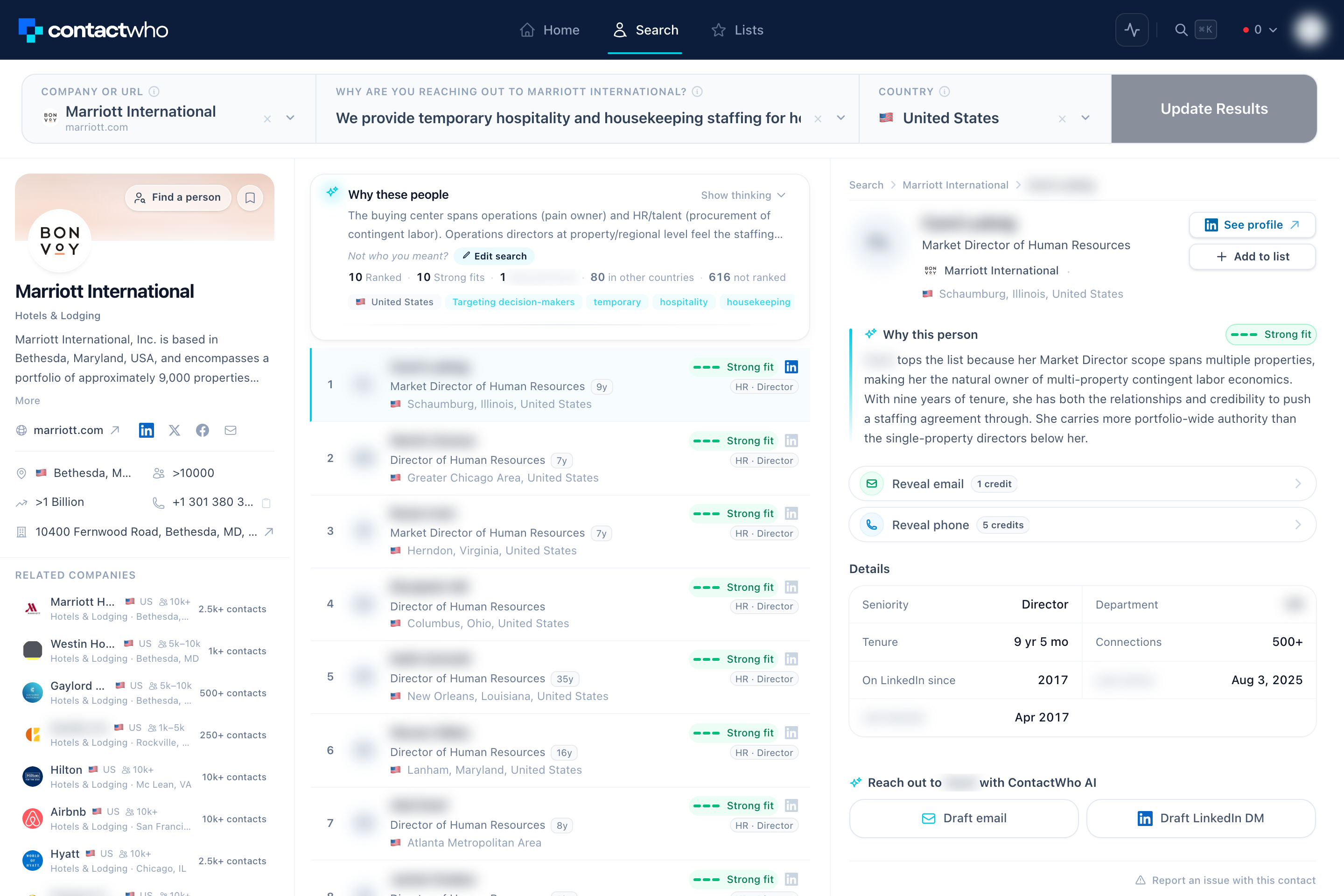
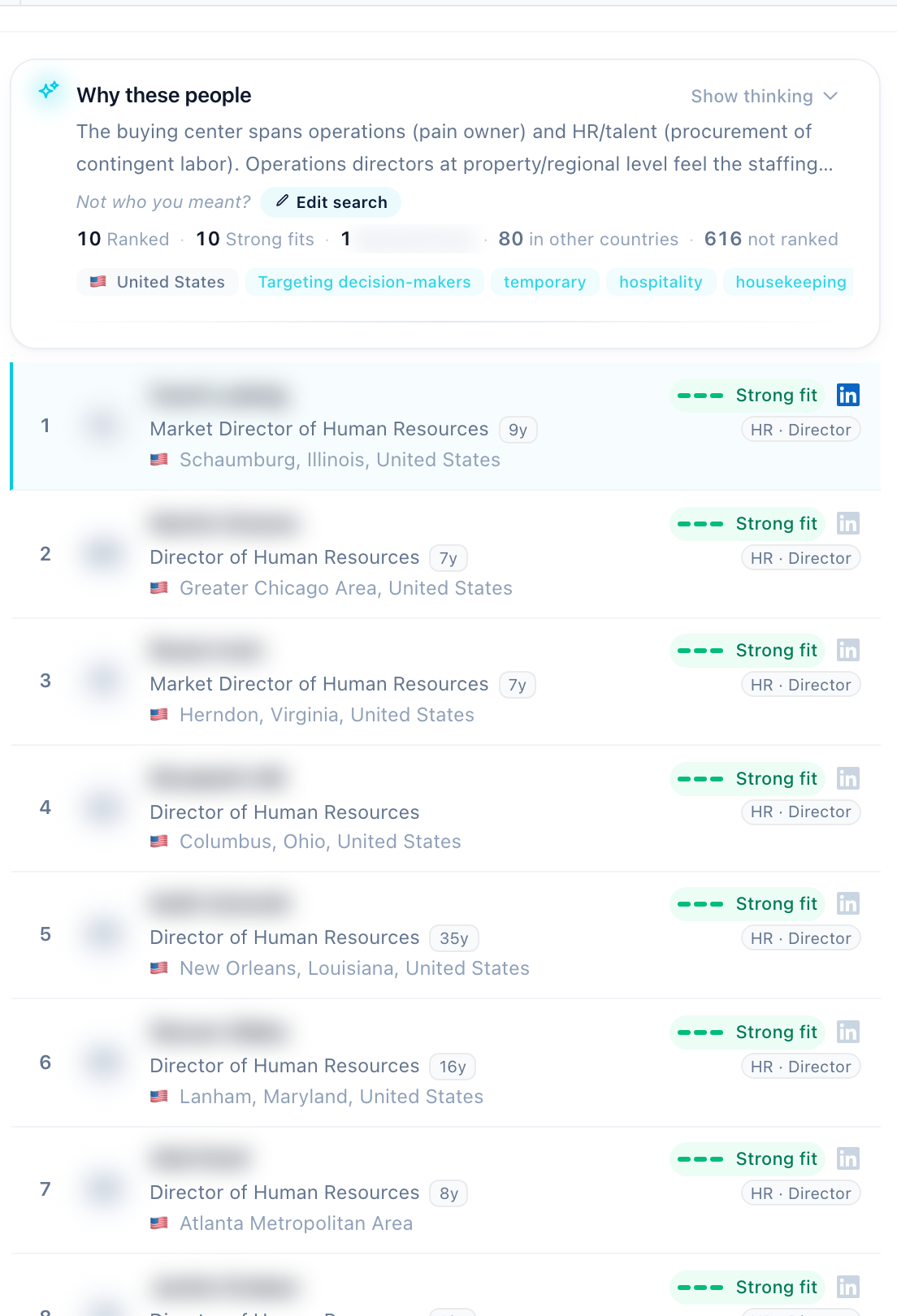
If you use a tool for the people-finding step, Contactwho is built for that middle part: type what you place plus a company name and it returns that company's people ranked by fit, with the reason each one is there and a verified email or phone when you need it. Whether you use it or a spreadsheet, the plan is the same.
- Week 1: choose one niche and one service line. Build a list of 100 target accounts. Attach a trigger to as many as you can.
- Week 2: name two or three people per account, defaulting to the HR manager, the head of TA and the hiring leader. Send first touches to 20 accounts.
- Week 3: send first touches to 20 more. Follow up on every week-2 touch. Re-engage 10 former clients or warm contacts.
- Week 4: same again. On Friday, count conversations by title and by trigger, and keep whatever produced them.
Do that for a month and you will know whether the problem is your market, your list, your message or your discipline. That is what most agencies are missing. Not more tactics. Proof about what works in their own market.