
Decision Maker vs Influencer vs Champion: Who Actually Moves the Deal?

Contactwho Research · How we write
Guides from the team that builds Contactwho, grounded in thousands of real buyer searches. Drafted with AI assistance, edited and fact-checked by people.
You've seen this happen. One rep says the VP is the buyer. Marketing insists the manager is driving the project. The founder thinks the CFO will block it anyway. Three smart people, one account, three answers. So, decision maker vs influencer vs champion, in one breath: the decision maker has budget authority and signs. The influencer shapes the evaluation but cannot sign. The champion is an influencer who actively sells for you internally and gets you in front of the decision maker. Most real deals need all three, treated differently.
That is why this is not just sales jargon. It is the difference between a deal that moves and one that lives in "promising" status for three months before quietly dying.
Teams get stuck because they keep looking for one magical contact. There usually isn't one. There is a buying committee, uneven power, and a few people who care for completely different reasons. HubSpot puts the number of decision makers involved in a typical sale at five. If you don't map them, your pipeline fills with confidence and very little control.
Decision maker vs influencer vs champion: what each one can actually do
Strip the roles down to the one thing each can do that the others cannot.
The decision maker can say yes to money
This is the person with the authority to say yes, no, or not now. Sometimes that authority is formal. Sometimes it is messy. In a small company it is the owner. In a larger one it is a department head with budget, a site leader, or occasionally a procurement process that behaves like a person.
The decision maker may not do the research. They may skip the first demo. They may barely care about your feature depth. But they control whether money gets committed. A contact can love what you sell and still have no power to buy it.
The influencer can change what "good" looks like
The influencer affects how the team thinks about the purchase. They define requirements, compare vendors, flag risks, or shape internal consensus. They do not sign, but they change the odds of who gets selected, often before the decision maker has heard your name.
Some influencers are positive, some are neutral, and some are quiet blockers. You do not need every influencer to love you. You do need to know which ones can slow the deal down.
The champion spends political capital for you
The champion is an influencer who has decided to act. They want your solution to win and are willing to spend energy making it happen. They introduce you to other stakeholders, explain the approval path, warn you about objections, and nudge things forward when the process goes dark.
Champions get confused with decision makers because they are engaged and enthusiastic. Those are not the same thing. Your strongest champion is usually one level below the person who signs, because that is where the pain lives. If you need to work out who actually holds the money, the guide on how to find the economic buyer covers that on its own.
Where the three roles land in two real purchases
Generic definitions are where most explanations stop. Titles are where they get useful. Here is how the three roles map onto actual jobs in two purchases we see constantly, using aggregated data from 3,166 completed searches run through Contactwho as of September 2026.
Staffing and recruiting services. In 574 staffing searches, 371 had a resolved buying center. HR leadership was the primary buying center in 50% and talent acquisition in 31%. Operations or plant leadership took 6%, and the owner or executive only 5%. The titles that landed in the top five most often were HR manager, head of talent acquisition and talent acquisition manager. Management level across those top-five slots: manager 32%, specialist 17%, head 9%, director 7%, C-level 1%.
Read that as a role map. The labeled buyer, the one who owns the agency relationship and signs the agreement, is the HR manager or head of TA. The hiring leader whose team has the open requisitions is the demand signal and the most natural influencer: their urgency is what makes HR pick up the phone. Who buys recruiting services at a company goes deeper on that split. The champion is usually the TA manager or specialist carrying those reqs day to day, because they are the one who feels it.
Industrial byproducts, scrap and off-spec material. In 1,391 searches, 713 had a resolved buying center. Operations or plant leadership led at 35%, sustainability or EHS at 34%, procurement or supply chain at 21%. Top-five titles: supply chain manager, key account manager, plant manager, operations manager, quality manager, purchasing manager. C-level took 1% of top-five slots.
The decision maker is the plant or operations manager, because the material is their cost and their floor space. EHS and sustainability shape the evaluation, and at plants with diversion or compliance targets they are the most likely champion. Procurement's share rises with company size but never leads. It is the gate, not the buyer.
| Role | Staffing services | Industrial byproducts |
|---|---|---|
| Decision maker (signs) | HR manager or head of talent acquisition; owner in only 5% | Plant or operations manager |
| Influencer (shapes) | Hiring leader with open reqs; procurement at larger employers | EHS or sustainability lead; quality manager; procurement |
| Champion (sells inside) | TA manager or specialist carrying the reqs | EHS or sustainability owner with a target to hit |
One more number worth holding onto. Across 185 staffing searches, the top five averaged 4.6 people: 2.5 primary buyers, 1.3 secondary, 0.7 influencers. In 455 industrial searches it was 4.5 people: 2.1 primary, 1.9 secondary. Two or three people can sign or nearly sign. The rest shape. That is the committee.
The test questions that tell you who you are talking to
You cannot ask someone "are you the decision maker?" Most people say yes, and most are wrong or embarrassed. Ask around the role instead.
To test for a decision maker:
- "If this moved forward, whose budget would it come from?"
- "How do purchases like this usually get approved here?"
- "Would you be the one signing the agreement?"
To test whether an influencer is worth investing in:
- "Does [the decision maker] always listen to your recommendations?"
- "Who else will be involved before this gets decided?"
- "What would make you say no to this?"
To test for a champion:
- "Would you be willing to bring [name] into the next conversation?"
- "If I send you a one-page summary, would you circulate it?"
Notice what these do. They do not force anyone to declare a role. They reveal the structure around the deal, and the answers sort people faster than any title filter.
Listen for patterns too. A likely decision maker asks about implementation effort, pricing at scale, and which quarter the money comes from. A likely influencer talks about integration, comparison with other options, and what their team would use every day. A likely champion offers to pull people in and asks how to frame it internally.
One person can play more than one role. In a 30-person company the owner may be all three. In a 3,000-person company, assuming one person covers all three is how you miss the real blocker.
Turning an influencer into a champion
Champions are not found. They are made, from influencers who already have a reason to care.
- Pick the influencer with the most personal stake. Not the most senior one. The person whose week gets worse if the problem stays. In staffing that is the TA manager with twelve open reqs. In byproducts it is the EHS lead with a diversion number on their scorecard.
- Give them something they can forward without you. One page, in their language: the problem cost, the expected upside, the timeline, the risk of doing nothing. Product decks do not travel internally. Business cases do.
- Pre-answer the objections they will face. Ask who is likely to push back, and on what. Then hand them the answer before they need it. A champion who gets ambushed once stops championing.
- Ask for the introduction explicitly. "Would you bring [decision maker] into the next call?" If they say yes and do it, you have a champion. If they say yes and never do, you have an influencer who likes you.
- Run the two-question test. Does the decision maker listen to them? Will they set up the meeting? Two yeses is a champion. One yes is an ally. Zero is a contact.
- Keep the ones who fail the test warm anyway. They still shape the shortlist. They just will not carry the deal, so find another route to the signer.
Where deals get mislabeled
Bad account strategy does not feel bad at first. It feels productive.
Mistaking responsiveness for authority. The contact replies fast, books meetings and asks smart questions. That still does not mean they can buy. Teams promote engaged contacts to "decision maker" because it feels efficient, then get blindsided by someone they never met.
Treating the champion like the economic buyer. A strong champion can carry a deal surprisingly far. If their enthusiasm substitutes for actual buying authority, you are building on hope. Ask about approval, budget source, and who else needs confidence before a decision happens.
Ignoring the quiet influencer. The person who says little on calls is sometimes the one everyone listens to after the call ends. Quality, EHS, finance, procurement and consultants are the usual suspects.
Filtering by title alone. "Head of," "Director of," and "VP of" mean different things at a 40-person firm and a 4,000-person one. In our staffing data the person you should write to is a manager or head far more often than a VP, and C-level appears in about one top-five slot in a hundred.
Chasing consensus too early. Looping in nine people before basic fit is established slows everything down. You need enough coverage to understand the process, not a committee call on day one. How to map a buying committee explains how to size that coverage.
Questions people ask
What is a champion in sales? A champion is a person inside the buying company who actively wants your solution to win and spends their own credibility to make it happen: introducing you, explaining the approval path, and pushing when things stall. Enthusiasm alone does not make a champion. Action does.
How do you know if someone is the real decision maker? Ask whose budget the purchase would come from and whether they would be the one signing. Then watch behavior: real decision makers ask about implementation cost, payback and timing, and they can name the approval steps without checking. If they need to "socialize it," they are not the signer.
Should you sell to the decision maker or the influencer? Both, but differently. The influencer needs to believe you are the safest, best-fit option, because they shape the shortlist. The decision maker needs the business case and the risk answer. Selling only to the decision maker skips the people who write the criteria; selling only to the influencer leaves you waiting on someone you have never met.
What is a blocker in sales? A blocker is a stakeholder who can slow or stop the purchase without ever being your buyer: procurement, legal, IT, finance, or a manager who prefers the incumbent. Most blockers are not hostile, just unconvinced or uninvolved. Find them early and give your champion the answer to their objection.
How many decision makers are involved in a B2B sale? HubSpot's figure is five decision makers per sale. Our own search data lands close: the top five people ranked for a purchase average about 4.5, of which 2 to 2.6 are primary buyers and the rest are secondary or influencers. Plan for four to six named people.
If your team keeps disagreeing, use this rule
Stop asking who the decision maker is. Label every contact with the evidence you actually have:
- Has pain
- Has influence
- Has approval
- Has motivation to champion
One person may earn two labels. Another only one. Now the argument is about evidence, not opinions, and the next move is usually obvious: if nobody has approval, find the signer; if nobody has motivation, build a champion; if nobody has pain, you may not have a deal.
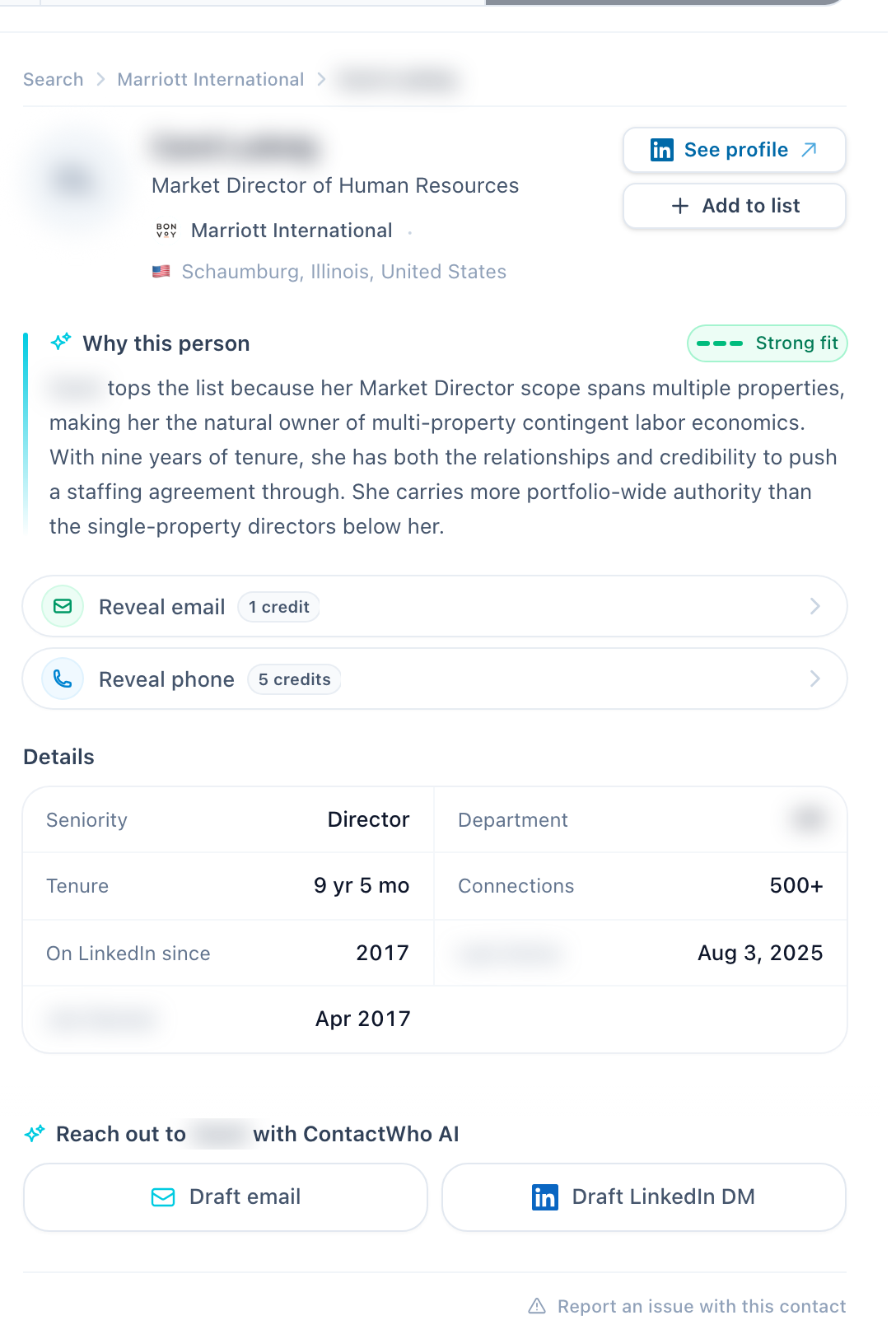
That first pass is what Contactwho is built to shorten: enter what you sell and a company name, and it ranks that company's people by fit for that purchase, with the reason each one made the list. It gives you the three-role map. Testing it still happens in the conversation.
Once you see decision maker vs influencer vs champion this way, the account gets a lot less mysterious. Not easy, but less fuzzy. Fix the role definitions first, and finding the right buyer gets much faster.