
How to Map a Buying Committee Before the First Call

Contactwho Research · How we write
Guides from the team that builds Contactwho, grounded in thousands of real buyer searches. Drafted with AI assistance, edited and fact-checked by people.
Most teams think there is one buyer. There usually isn't. So, how to map a buying committee: list every role that can approve, influence or block the purchase, attach a real name and title to each, and rank them by influence. Done properly that gives you four to six named people to work instead of one, and most of it can be built from public data before the first call.
That is why smart people can stare at the same account and still argue about who owns the decision. One person controls budget. Another owns the problem. Another can block rollout. Someone else will be asked for "input" and quietly kill momentum. If your account plan does not reflect that, it is not a plan. It is optimism.
Most mapping advice was also written for software. "Technical evaluator" and "end-user champion" mean nothing when you are selling temp labor to a distribution center or buying off-spec material from a plant. What follows works for those purchases too.
A role list that fits purchases that are not software
Six roles cover almost any B2B purchase. One person can hold two.
- Approver. Signs, or can veto without being overruled. The economic buyer. Plant manager, head of talent acquisition, owner.
- Owner. Runs the purchase day to day and manages the vendor afterwards. The department we label the "primary buying center." Often a manager, not a director.
- Evaluator. Checks fit, compliance or quality. Quality manager, EHS lead, IT, legal, the hiring manager who interviews your candidates.
- User. Lives with the result. Shift supervisors, hiring managers, material handlers, the team that gets the temps.
- Gatekeeper. Controls the process, not the decision. Procurement, purchasing, a managed-service provider, a vendor portal.
- Champion. Not a title. Any of the above who actively sells for you inside. Decision maker vs influencer vs champion explains how to tell one from an enthusiastic contact.
Names later. Roles first: if you do not know which roles are empty, you cannot know whether your coverage is real.
A title-to-role heuristic you can apply from a profile
Nobody tells you their role. You infer it from title, scope and company size. This table is the shortcut, built on which titles actually land in the top five across our searches.
| Title pattern | Likely role | Notes |
|---|---|---|
| Owner, founder, managing director, GM (under about 250 people) | Approver | Signs; rarely runs the purchase |
| Plant manager, site director, director of operations | Approver or owner | Signs for site-level spend; the usual signer in byproduct deals |
| Head of, director of [function] | Owner, sometimes approver | Approver at mid-size firms; owner at large ones |
| [Function] manager (HR, TA, supply chain, purchasing, operations) | Owner | The most common top-five level: manager 32% in staffing, 25% in industrial |
| EHS, sustainability, quality manager | Evaluator, sometimes champion | Can veto on compliance; often holds a target your offer helps hit |
| Specialist, coordinator, analyst | User or evaluator | Does the work; strong champion candidate, weak signer |
| Procurement, purchasing, category, sourcing | Gatekeeper | Leads in only 3% of searches; share rises with company size |
| Key account manager, sales (in byproduct deals) | Owner or evaluator | When you are buying their material, their sales side is on the committee |
| C-level, outside owner-run firms | Rarely on the map | About 1% of top-five slots in both staffing and industrial searches |
The last row is the one most teams get wrong: executives are on the org chart, almost never on the committee.
How big the committee really is
Gartner's research puts a typical B2B buying group at 6 to 10 stakeholders. McKinsey has reported that deals with three or more engaged stakeholders close at two to three times the rate of deals with fewer. Together: you do not need all ten, you need several who are engaged.
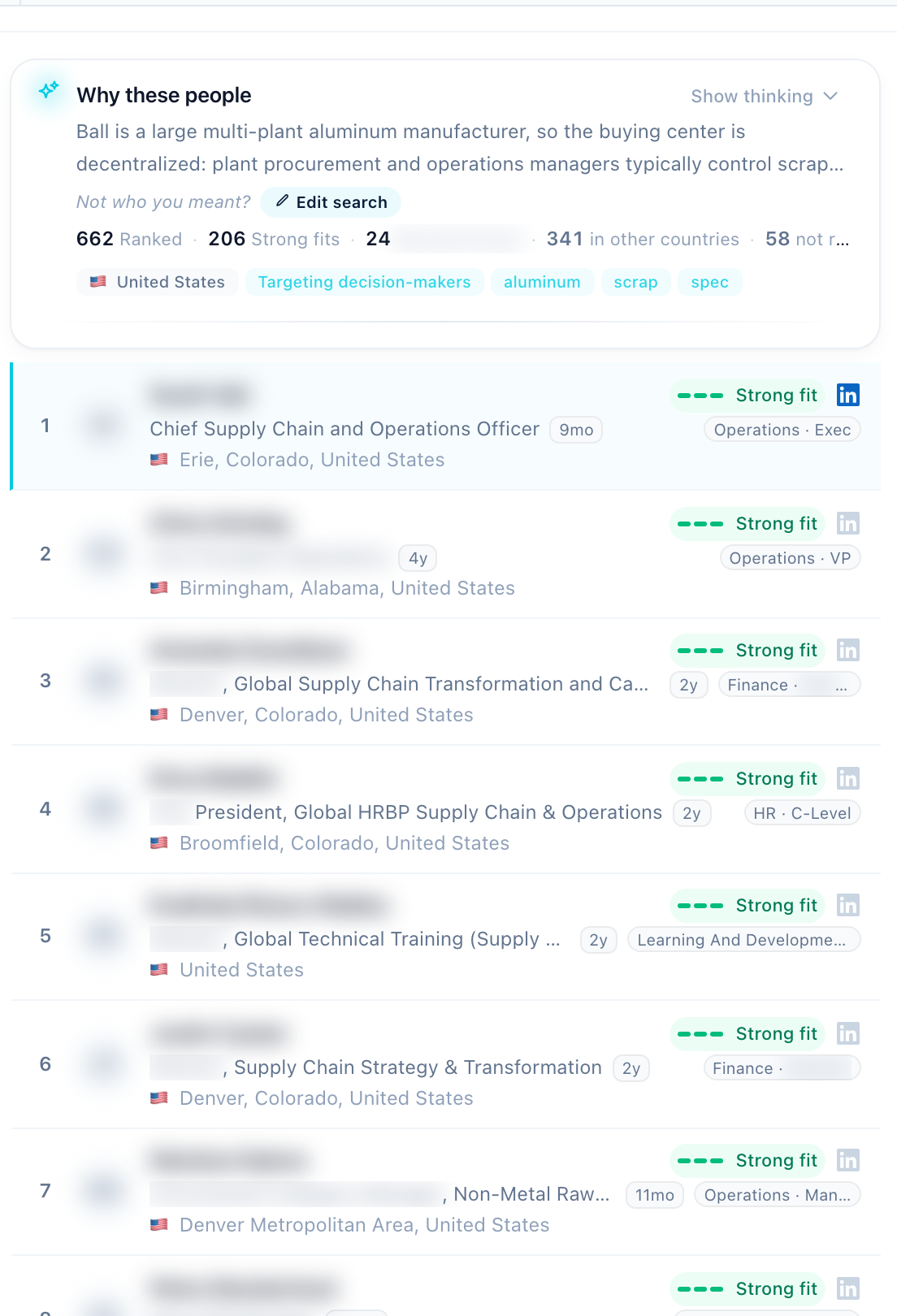
Our own data says where the middle sits. For every search, Contactwho ranks a company's people and marks a top five, labeling each as primary, secondary or other. Across 3,166 completed searches as of September 2026, the top five averages about 4.5 people, of which 2 to 2.6 are primary.
| Purchase | Searches with a top five | People in top five | Primary | Secondary | Other |
|---|---|---|---|---|---|
| Staffing and recruiting services | 185 | 4.6 | 2.5 | 1.3 | 0.7 |
| Industrial byproducts, scrap, off-spec | 455 | 4.5 | 2.1 | 1.9 | 0.5 |
| Packaging (small sample) | 14 | 2.6 | 1.7 | 0.7 | - |
Read it as a committee shape. Two to three people can sign or run the purchase. One or two shape it. One more sits at the edge. So the practical target is four to six named people: fewer than Gartner's headcount, because you are naming only the ones who matter, and more than the single contact most outbound stops at.
The department mix tells you where to start. In 371 staffing searches with a resolved buying center, HR leadership was primary in 50% and talent acquisition in 31%. In 713 industrial byproduct searches, operations or plant led at 35%, sustainability or EHS at 34%, procurement at 21%. Begin in the department that leads for your purchase, then fill the other rows.
The buying committee worksheet
Nobody publishes a usable template, so here is one. Every row gets an evidence level, because a map that is confident about bad assumptions is worse than an empty one.
| Role | Name | Title | Evidence (public / inferred / confirmed) | Stance (for / neutral / against / unknown) | What they need to hear | Next touch |
|---|---|---|---|---|---|---|
| Approver | ||||||
| Owner | ||||||
| Evaluator | ||||||
| User | ||||||
| Gatekeeper | ||||||
| Champion |
Filled in for a byproduct purchase at a mid-size plant before any call, titles only because that is all public data gives you:
| Role | Title | Evidence | Stance | What they need to hear |
|---|---|---|---|---|
| Approver | Plant manager | Public, site leadership page | Unknown | Cost per ton out the door, no disruption to the line |
| Owner | Operations manager | Public | Unknown | Pickup reliability, paperwork handled |
| Evaluator | EHS or sustainability lead | Public | Unknown | Diversion numbers, chain of custody |
| Evaluator | Quality manager | Inferred from plant size | Unknown | Off-spec handling never touches product quality |
| Gatekeeper | Purchasing manager | Inferred | Unknown | Vendor onboarding steps, insurance |
| Champion | Not yet identified | - | - | Whoever's scorecard your offer improves |
Five titles, one gap, every stance unknown. That is a good map on day one. Stance and champion fill in during the first two conversations.
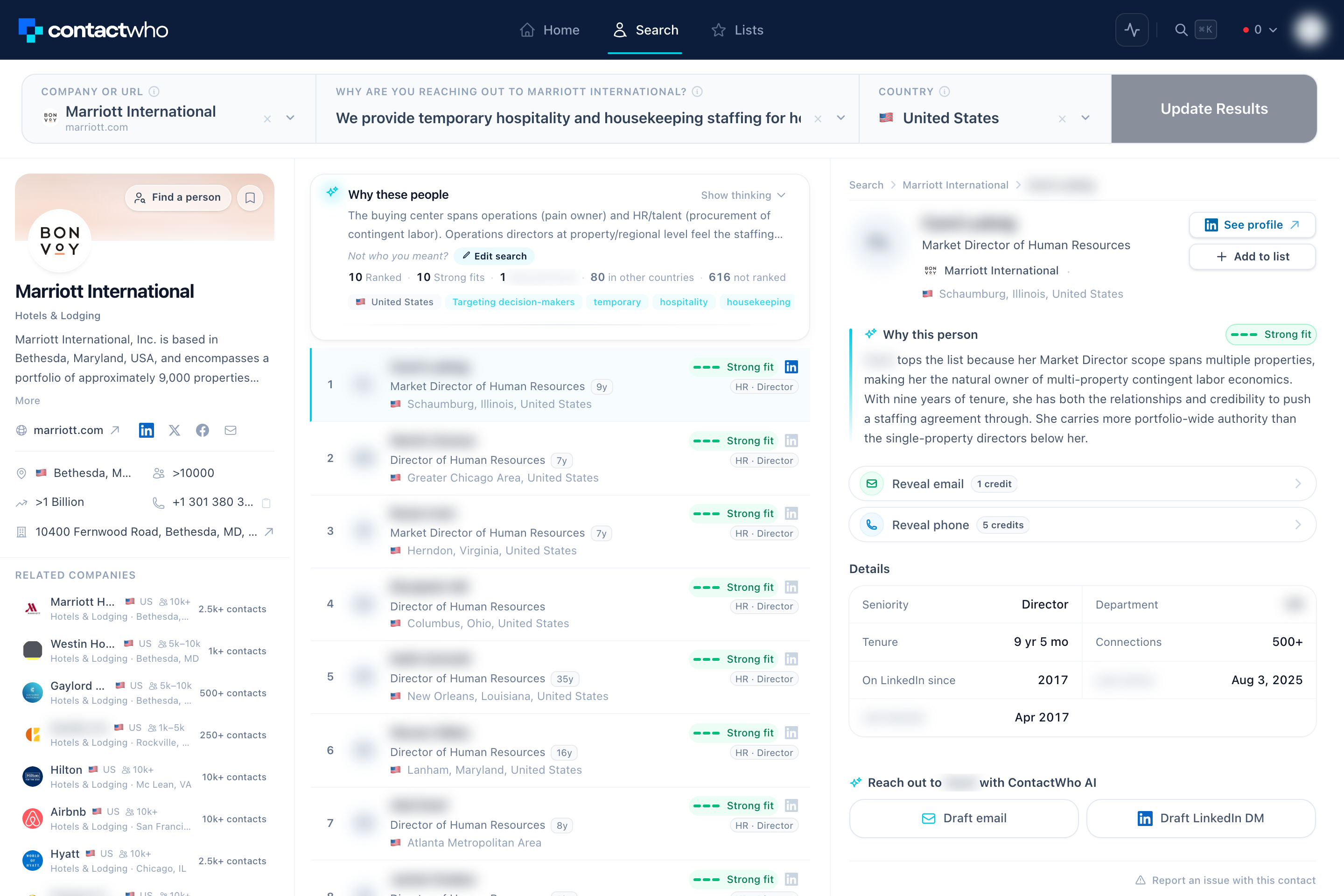
For a staffing purchase the rows change but the shape does not: head of TA or HR manager as approver, TA manager as owner, the hiring manager with open reqs as evaluator and user, procurement or an MSP as gatekeeper at larger employers. Who buys recruiting services at a company goes deeper on that one.
Mapping the committee from outside, before any call
You can map a 200-person company you have never spoken to. Most of the way, anyway.
- Write the purchase in one sentence. Not your category, their decision: "replace the scrap hauler at the Ohio plant" or "add an agency for the Q4 warehouse ramp." Different decisions pull in different roles.
- Pick the leading department for that purchase. Use the data above: HR or TA for staffing, operations or EHS for byproducts, packaging or NPD for packaging. That department gives you the owner row and usually the approver.
- Adjust for size. Under about 50 people, the owner is the approver and one manager covers owner, evaluator and user. From 250 to 1,000, expect a real evaluator and a purchasing gatekeeper. Above a few thousand, map the site or region, not headquarters.
- Pull titles from public sources. Leadership pages, professional profiles, press releases about site openings or new hires, job postings that name the department, and for plants, environmental permits naming a responsible manager. Mark each row public or inferred.
- Fill four to six rows, no more. Ten names with no evidence is noise. If a row is empty, leave it empty and note what would fill it.
- Validate on the first call with two questions. "Who else will be involved before this gets decided?" and "If this moved forward, whose budget would it come from?" Then correct the map. Expect to change at least one row.
Where committee maps go wrong
Confusing seniority with relevance. If the VP is detached and the manager is driving the process, you need both, but not for the same reason. Our data says the manager is on the map far more often than the VP.
Stopping at the first engaged contact. Someone replies, takes a meeting, sounds interested, and the whole team behaves as if the account is covered. Interest is not ownership. One row filled is not a map.
Ignoring invisible blockers. Nobody thinks about purchasing, legal, EHS or the MSP until they add six weeks. If your offer touches compliance, headcount or a vendor list, they are on the committee whether you map them or not.
Treating the org chart as the decision path. Org charts show reporting lines, not trust, political capital, or who gets pulled in when things get risky. Structure, not power.
Collecting contacts like trading cards. More people is not the goal. The right person in each row is. Every new name should fill an empty role, correct the map, or get you closer to the approver. How to find the economic buyer covers that row on its own.
Questions people ask
How many people are on a buying committee? Gartner's research says 6 to 10 stakeholders touch a typical B2B purchase. In our search data the top five people who matter for a purchase average about 4.5, of which 2 to 2.6 are primary buyers. Name four to six; the rest are context.
Personas vs buying committee map, what is the difference? A persona is a generic description of a type of buyer, useful for messaging. A committee map is a list of real, named people at one account with their role, evidence and stance. Personas tell you what to say. The map tells you who to say it to, and whether you are missing someone.
Should we map before or after the first call? Before, in pencil. Public data gets you titles for four to six roles and a hypothesis about who signs. The first call exists to correct that map, which is a far better use of it than starting from zero. Then keep correcting after every conversation.
Can I use Sales Navigator to map committees? Yes, for the raw material: titles, reporting hints and headcount. It will not tell you which title holds which role for your specific purchase, or which of the eleven "managers" matter. You still need the heuristic above and, at some point, a conversation.
How often should maps be refreshed? Every 30 days on an active account, and immediately after any call that surfaces a new name or a change of stance. People move, budgets shift and procurement arrives late. A map older than a quarter should be treated as inferred, not confirmed.
A 30-day plan
Contactwho does the first draft of this for one company at a time: enter what you sell and the company name, and it returns that company's people ranked by fit, marked primary or secondary, with the reason each one is there. It does not tell you their stance. That is what the calls are for.
- Days 1 to 5. Pick 20 target accounts. For each, write the purchase in one sentence and pick the leading department.
- Days 6 to 12. Fill the worksheet for all 20 from public data: four to six rows each, every row marked public or inferred. Leave gaps visible.
- Days 13 to 25. Reach the owner row first, with a message that names the purchase, not your category. Ask the two validation questions on every call. Correct the maps.
- Days 26 to 30. Look at which rows were wrong most often. That pattern is your title-to-role heuristic for the next 20 accounts, and it is worth more than any template, including this one.