
Who Handles Scrap and Recycling at a Manufacturing Plant (and Who Actually Signs)

Contactwho Research · How we write
Guides from the team that builds Contactwho, grounded in thousands of real buyer searches. Drafted with AI assistance, edited and fact-checked by people.
Walk the yard of any plant with a loading dock and you will see the same three things: a roll-off, a baler, and nobody's name on either. That is the whole problem in one picture.
Who handles scrap and recycling at a manufacturing plant depends on what you mean by handle. Operations owns volume and logistics. EHS or sustainability owns diversion and compliance. Procurement owns the contract and price. Across 713 industrial searches with a resolved buying center, those three split ownership 35%, 34% and 21%. The signer is usually a manager, not an executive.
Why three departments share one roll-off
Nobody can answer the title question in one word because scrap is not one job. It is three jobs that happen to touch the same container.
Operations makes it. Every shift throws off offcuts, skeletons, purge, trim, rejects and dunnage. Somebody has to bin it by grade, bale it, stage it and get it off the floor before it blocks a forklift lane. That somebody reports to the plant manager. Volume, separation, pickup cadence, container swaps: operations.
EHS answers for it. Diversion rate, landfill tonnage, hazardous classification, the certificate that proves the drums went where they were supposed to go, the line in the corporate sustainability report. When a plant has a zero-landfill or diversion target, the environmental or sustainability lead is the one who has to explain the number every quarter. The EPA puts the energy saving from recycling steel at 60 to 74 percent against virgin production, and figures like that are why diversion became a reportable metric with an owner attached.
Procurement papers it. Hauler contract, index-linked pricing, rebates, insurance certificates, payment terms, the argument about whether the plant is a seller of material or a buyer of a service. At a 60-person shop this is the controller or the purchasing manager. At a 6,000-person group it is a category manager for indirect spend who has never stood next to the baler.
The Institute of Scrap Recycling Industries counts roughly 120 million tons of scrap moving through the US each year. None of it is sold by a department called scrap. It is sold by a triangle, and which corner you approach first depends on what you are offering.
Who handles scrap and recycling at a manufacturing plant: what 1,391 searches show
Contactwho users ran 1,391 searches with an industrial byproduct, scrap, recycling or off-spec intent against real manufacturers, mostly in the US (1,008 searches), Mexico (106), Canada (82) and the UK (34). For 713 of those searches the model resolved a primary buying center, the department that owns the decision.
| Primary buying center | Share of 713 resolved searches |
|---|---|
| Operations / plant | 35% |
| Sustainability / EHS | 34% |
| Procurement / supply chain | 21% |
| Packaging / NPD | 2% |
| Sales leadership | 2% |
| Executive | 2% |
| Other | 4% |
Operations and EHS are a coin flip. Procurement is a clear third. The executive suite owns the decision in 2 percent of cases, which is worth sitting with if your current list is full of CEOs.
Cut the same searches by company size and a pattern shows up that the overall split hides.
| Company size | Searches | Sustainability / EHS | Operations / plant | Procurement |
|---|---|---|---|---|
| Under 250 employees | 840 | 49% | 29% | 17% |
| 250 to 999 | 181 | 51% | 28% | 15% |
| 1,000 to 4,999 | 120 | 43% | 30% | 19% |
| 5,000 and up | 184 | 49% | 27% | 22% |
Two things. First, the environmental or sustainability owner leads in every band, including the small plants where you might expect the owner to be handling it personally. Second, procurement's share moves from 17 percent at the small end to 22 percent at 5,000-plus employees, but it never leads. Bigger company, more paperwork, same answer about who to email first.
The top five is 4.5 people, and one of them is a quality manager
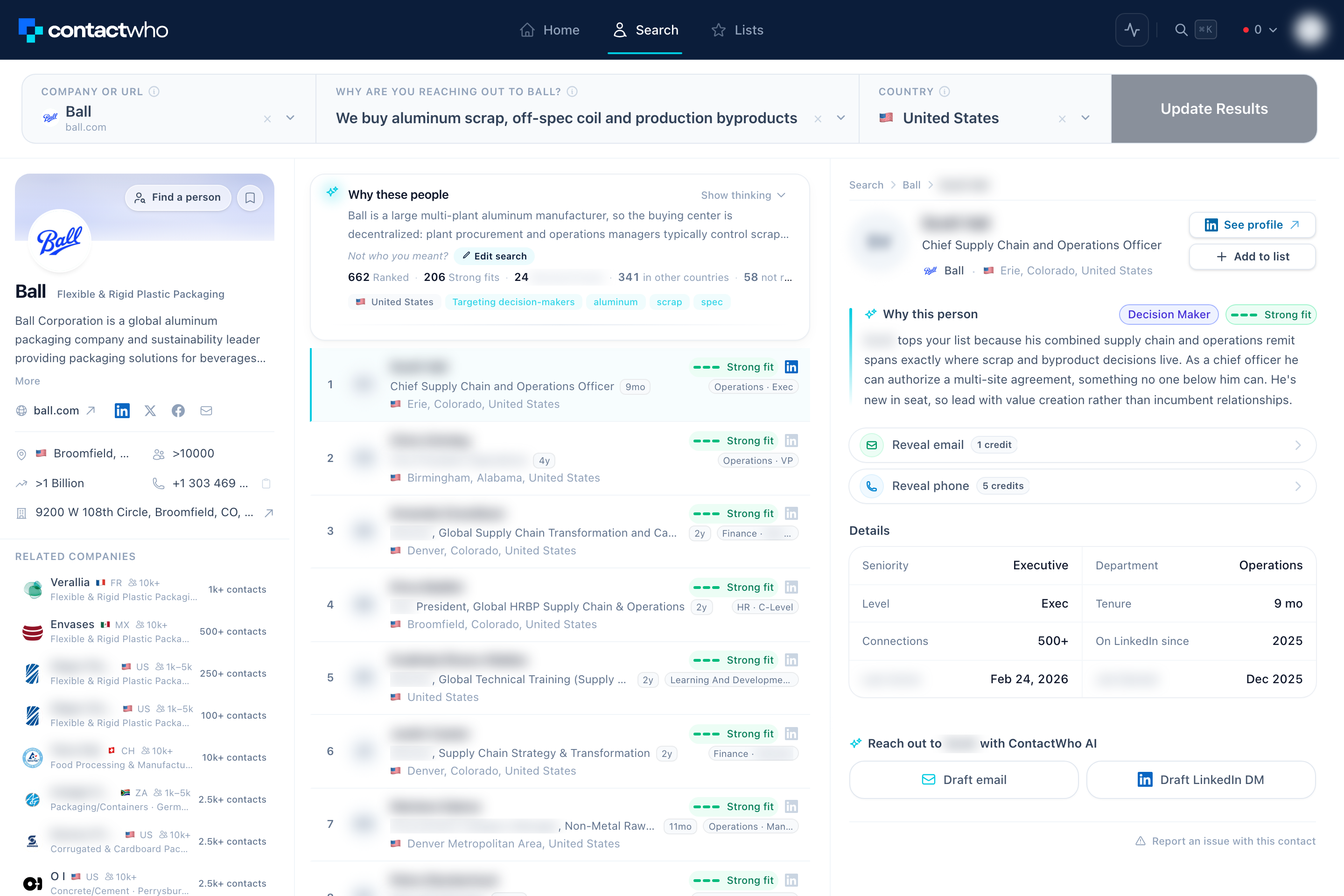
Across 455 of these searches with a marked top five, the list held 4.5 people on average: 2.1 primary buyers, 1.9 secondary, 0.5 influencers or stakeholders. Not one person. Not a committee of ten either. Two people who can say yes and two who can say no.
The titles that land in that top five, from 1,124 people across 261 searches with title data:
| Title | Appearances |
|---|---|
| Supply chain manager | 39 |
| Plant manager | 29 |
| Operations manager | 29 |
| Quality manager | 25 |
| Purchasing manager | 18 |
| Procurement manager | 14 |
| Director of operations | 14 |
| Supply chain director | 14 |
Quality manager is the entry people do not expect. It makes sense the moment you remember that off-spec material only exists because someone in quality rejected it. If you buy seconds, regrind or out-of-tolerance lots, the quality manager decides how much of it there is and whether it can leave the building with the company's name on the pallet.
Seniority tells the rest of the story. Of those 1,124 people, 25 percent hold a manager title, 5 percent are directors, 2 percent are heads, and 1 percent are C-level (56 percent could not be classified). For every executive in a top five there are roughly 25 managers. The person who signs a hauling contract or approves a material sale is, in most plants, a plant manager, an operations manager or a purchasing manager. The person who can quietly stall it is the EHS lead nobody looped in.
Three doors, three different first sentences
Same plant, three owners, three different reasons to reply. Sending one generic "we buy scrap" note to all three is how you get zero replies from all three.
The operations door. Plant managers and operations managers compare hassle, not index prices. They care whether the box is full on a Friday afternoon, whether the truck shows up when it said it would, whether you supply the containers and the baler wire, and whether you take the awkward stream as well as the easy one. Open with logistics: what you take, how often, what equipment you bring, and one specific grade you already know they produce. Leave price for the second conversation.
The EHS or sustainability door. This person is graded on diversion and documentation. Open with what you can prove: certificates of recycling or destruction, chain-of-custody paperwork, a diversion figure they can drop into a report. If the company has a published zero-landfill or diversion target, name it in the first sentence. Do not open with tonnage; they already know the tonnage.
The procurement door. Purchasing managers, procurement managers and supply chain managers want commercial structure. Term length, index-linked pricing, rebate mechanics, a certificate of insurance, consolidated invoicing across sites, and a reference from a plant that looks like theirs. Open with the structure of the deal, not the romance of the material. Then let them pull the operations and EHS owners into the room, because they will anyway.
Which door first? Match it to your offer. Hauling and logistics, go operations. Documentation and diversion, go EHS. Multi-site consolidation, go procurement. If you cannot tell, the size table above says EHS, at every size. The logic in how to find the economic buyer applies here too: the buyer is whoever can say yes without asking anyone else, and in a plant that is rarely the executive floor.
A ten-minute account map before the first email
- Name the stream. Ferrous, non-ferrous, plastics, paper and board, chemical, off-spec finished goods. The owner shifts with it: quality for off-spec, EHS for anything regulated, operations for bulk.
- Size the company. Under 250 employees, expect one person wearing two hats; the EHS lead may be the plant manager on alternate Tuesdays. Over 5,000, expect three separate people and a category manager you have never heard of.
- Write down three names, not one. One operations name, one EHS or sustainability name, one purchasing name. That mirrors the shape of the top five: about two primary buyers and two secondary.
- Check the reporting line. A supply chain manager at a single-site company is usually the buyer. A supply chain manager at a 20-site group may be a regional coordinator with no signature. If you want a method, how to map buying committees covers it for any purchase.
- Verify before you send. In our reveal pipeline, pattern-guessed emails failed verification 38 percent of the time (207 of 539 pattern guesses); how to find verified work emails covers the method. A bounced first email to a plant manager is a first impression you do not get back.
- Write three first sentences, one per door, and send the one that matches what you actually sell first.
Where scrap buyers lose the plant before the first pickup
Emailing the CEO. C-level holds 1 percent of top-five slots in this data, and the executive suite is the primary buying center in only 2 percent of resolved searches. Start below.
Treating sustainability as a soft title. Buyers who came up through the metals trade sometimes read "sustainability manager" as marketing. The data disagrees at every company size. That person owns the number your service changes.
Sending one email, then waiting. The top five averages 4.5 people. Gartner puts a typical B2B buying group at 6 to 10 stakeholders; scrap is smaller than that, but it is still not one person. If your one contact goes quiet, the account did not say no. One person did.
Opening on price with operations. The plant manager does not have the index open. Price is procurement's language. Logistics is theirs.
Forgetting quality on off-spec. If you buy seconds and never speak to the quality manager, you are negotiating for material somebody else controls.
Assuming the incumbent hauler closes the door. Procurement holds the contract. Operations and EHS hold the reasons to change it. A full box on Friday and a missing certificate are two different reasons; find out which one they have.
Questions people ask
Who is responsible for scrap metal at a factory? Day to day, the plant or operations manager: it is their floor space and their forklift lanes. The contract with the buyer or hauler sits with purchasing or the controller, and the diversion and compliance record sits with EHS. Across 713 resolved industrial searches, operations was the primary owner 35 percent of the time and EHS 34 percent, so the honest answer is two people, sometimes three.
How do I buy scrap directly from a manufacturer? Find out what streams the plant produces, pick the one you can handle better than the incumbent, and approach the owner of that stream with a logistics offer rather than a price. Expect procurement to enter once the plant manager is interested, and expect EHS to ask for documentation. Have a certificate of insurance and a reference ready before either of them asks.
Who buys industrial byproducts? Mills, foundries, recyclers, brokers, converters and, for off-spec finished goods, secondary-market buyers who resell under another label. On the plant side the seller is rarely a dedicated role: in this data it is a supply chain, plant, operations or quality manager, with an EHS or sustainability lead approving the paperwork.
Does a facility need a third-party scrap partner? Small plants often use a single hauler and call it done. That works until someone has to produce a diversion figure for a customer audit or notices that mixed grades are being sold at the lowest grade's price. A third party earns its place when it separates grades, documents the chain of custody, and takes the awkward streams, not just the clean ones.
The next 30 days at 30 plants
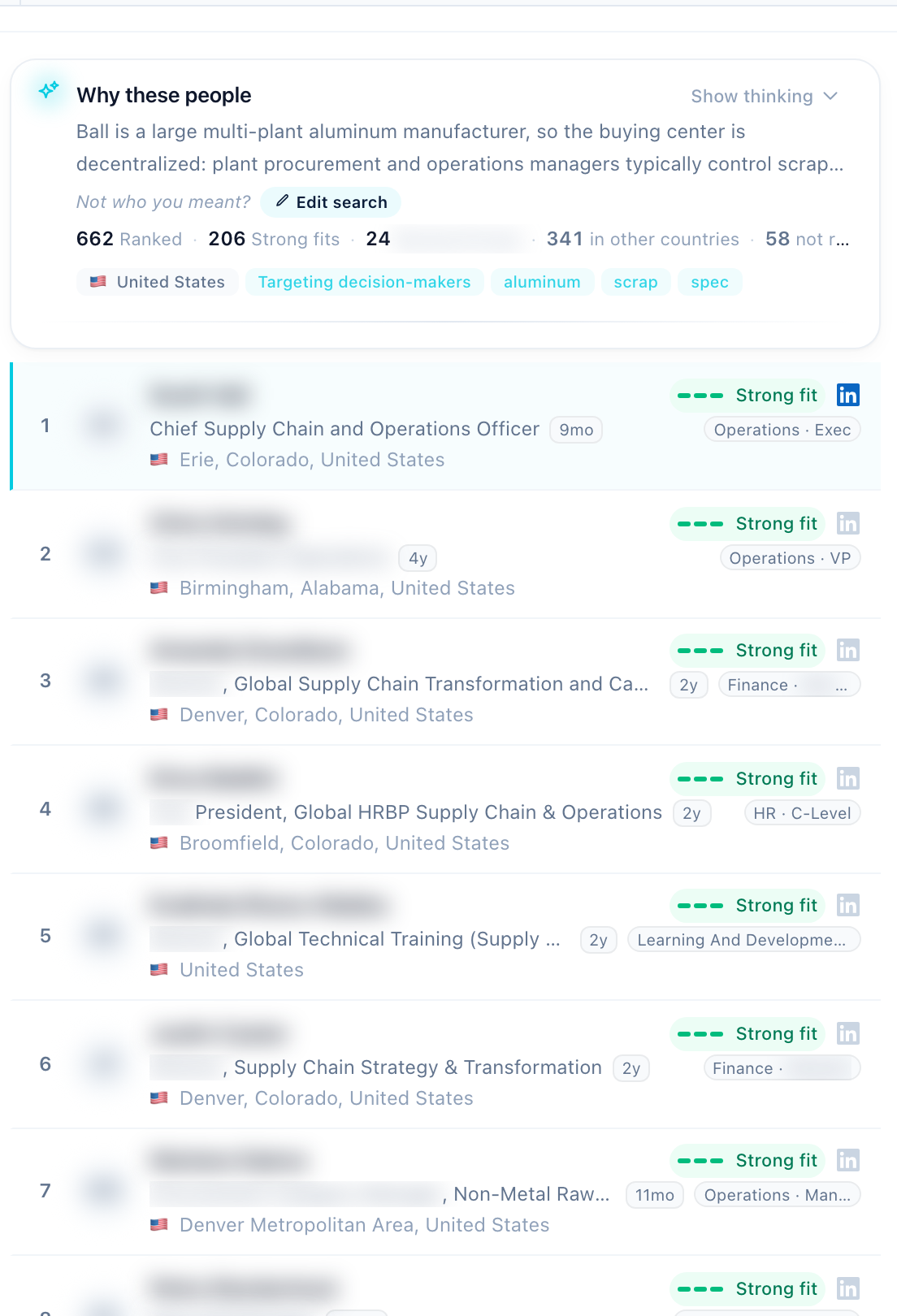
If you want the three names at a plant without an afternoon on LinkedIn, Contactwho takes what you buy plus the company name and returns that plant's people ranked by fit, with the department label next to each and a verified email or phone on reveal. It will not tell you what their turnings are worth. It tells you who to ask.
Then run this.
Week 1. Pick 30 plants and one stream per plant. Write down which door your offer belongs at.
Week 2. Name three people at each: operations, EHS, purchasing. Verify every email before it goes anywhere.
Week 3. Send the door-specific first sentence to the matching owner. Copy nobody.
Week 4. Sort replies by department, not by plant. If EHS answered and operations did not, that is your opener for the next 30.
Nobody at a plant is called the scrap person. Stop emailing as if someone is.